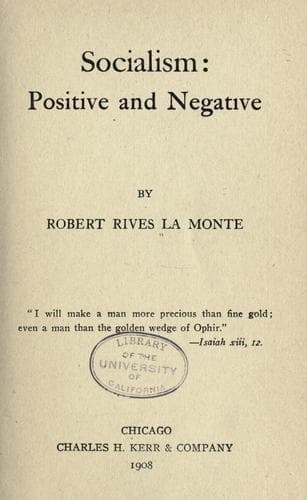
Socialism: Positive and NegativeLa Monte, Robert Rives
Philosophy
Socialism: Positive and Negative
La Monte, Robert Rives
Socialism
The most striking phenomenon in the field of ethics to-day is the rapid
growth of the new proletarian morality; and one of the principal
functions of the Socialist agitator and propagandist is to facilitate
and further this growth. He is the teacher of a new morality and, if one
accepted Matthew Arnold's definition of religion as "morality touched
with emotion," he might be called the preacher of a new religion. Let
who will call this sentimentalism, it is none the less hard fact. For,
after all, this new proletarian ethic is nothing else than
class-consciousness under a new name. And what Socialist will deny that
the chief function of the militant Socialist is to develop
class-consciousness in the workers? The one hope of the world to-day is
in the victory of the proletariat--aye, it is more than a hope, it is a
certainty; but this victory can only be won by a proletariat permeated
with the sense of solidarity; and the workingman imbued with this sense
of proletarian solidarity will be a living incarnation of the new
morality.
And what is this class-consciousness which it is our business to preach
in season and out of season? There is probably no term in the whole
technical vocabulary of Socialism which grates so unpleasantly on the
ear of the _petit bourgeois_ who "is coming our way" as this one of
"class-consciousness." To say class-consciousness is not to say class
hatred; though class-consciousness ofttimes develops into class hatred
and does not thereby become the less effective. The Socialist recognizes
in the words of Edmund Burke that "Man acts not from metaphysical
considerations, but from motives relative to his interests," and hence,
he regards it as his first duty to show his fellow-workers that their
economic interests are in direct conflict with those of the
master-class. He does not create this conflict by pointing it out; he
merely shows the working class "where they are at."
Public-domain text, read in full here on John Shaqi.
Reviews
Reviews
No reviews yet
Be the first to share your thoughts on this work.
Join the Discussion
Join the discussion
Sign in to leave a comment or review.
Sign InorCreate an account