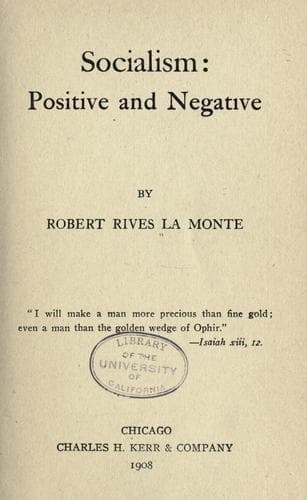
Socialism: Positive and NegativeLa Monte, Robert Rives
Philosophy
Socialism: Positive and Negative
La Monte, Robert Rives
Socialism
The passengers whose train has come to a standstill on a steep up-grade
owing to the inefficiency of the engine, will not fail to greet with a
hearty cheer the approach of a more powerful locomotive. In the same
way, Socialist workingmen, though they know that no human act deserves
either praise or blame, though they know, in the words of the wise old
Frenchman, that "_comprendre tout, c'est pardonner tout_," or, better
yet, that to understand all is to understand that there is nothing to
pardon, will not be chary of their cheers to him who is able to advance
their cause, nor of their curses upon him who betrays it. And in so
doing they will not be inconsistent, but will be acting in strict
accordance with that law of cause and effect which is the very fundament
of all proletarian reasoning; for those cheers and curses will be
potent factors in causing such conduct as will speed the social
revolution.
While we have no respect for current morality, we must not fall into the
error of supposing that there are no criteria by which to judge conduct,
that there are, so to say, no valid distinctions between the acts of a
hero and those of a blackguard. By referring to the ethic inspiring the
actor we can always pronounce some conduct to be fine and other acts
base. It is this power of a fine or noble action to thrill the human
heart that makes the triumphs of dramatic art possible. The dramatists,
like Shakespeare, whose characters accept the current moral code, appeal
to a wide audience--to nearly all. But those dramatists, such as Ibsen,
Shaw, Maeterlinck, and above all, Sudermann, whose heroes and heroines
attempt to put into practice the ideals of to-morrow in the environment
of to-day, are misunderstood and disliked by the majority, and
understood and appreciated only by the few who, like themselves, have
rejected the current code and adopted the criteria of to-morrow. But
those of us who call Sudermann the first of living dramatists, do so on
account of the extreme nobility of his heroines' conduct judged by the
criteria of the future.
While there will be no morality in Socialist society; while in the
perfect solidarity of a classless society there can be no conflict of
individual with social interests; there will nevertheless be certain
actions exceptionally fitted to increase the welfare and augment the
happiness of the community, and the men and women who perform these acts
will undoubtedly be rewarded by the plaudits and the love of their
comrades. Indeed, we with our debased standards are incapable of
conceiving how dear to them this reward will be. It is because I believe
that this love of one's fellows under Socialism will be a joy far
exceeding in intensity any pleasure known to us, that I look for
dramatic art to reach under Socialism a perfection and influence to-day
inconceivable.
Public-domain text, read in full here on John Shaqi.
Reviews
Reviews
No reviews yet
Be the first to share your thoughts on this work.
Join the Discussion
Join the discussion
Sign in to leave a comment or review.
Sign InorCreate an account