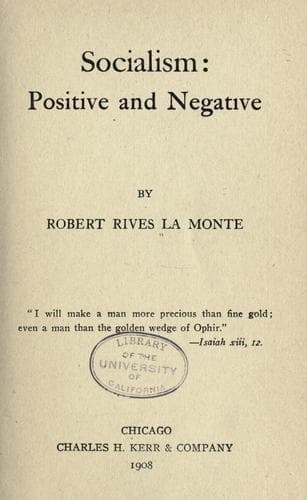
Socialism: Positive and NegativeLa Monte, Robert Rives
Philosophy
Socialism: Positive and Negative
La Monte, Robert Rives
Socialism
So that my contention that morality only came into being with the
division of society into classes and will pass away when class divisions
are abolished, becomes a question of definition. If we include in our
definition of morality the almost universal and relatively permanent
gregarious traits of men and beasts, then morality has existed longer
than humanity itself, and will continue to exist under Socialism. But it
cannot be denied that moral codes were not formulated until after
class-divisions had arisen. Every moral code of which we have any
knowledge has been moulded by the cultural discipline of a society based
on class-divisions. In every one of them there is implied the relation
of status, of a superior, natural or supernatural, with the right or
power to formulate "commandments," and of an inferior class whose lot it
is to obey. We find this implication of status in even the noblest
expressions of current ethical aspirations. Wordsworth's immortal Ode to
Duty begins, "Stern Daughter of the Voice of God!"
Since then morality as a word through the force of immemorial habit
unavoidably suggests to the mind the relation of status, it appears to
me that its use to describe truly social conduct in a society of equals
can lead to nothing but confusion. What we really need is the right
word to apply to the highest conduct in a classless society; and, I am
inclined to think that a generation to whom the idea of status will have
become wholly alien will find the word "social" entirely adequate for
this purpose, though I frankly confess it is not adequate for us
"In the days of the years we dwell in, that wear our lives away."
My statement that the Revolutionary worker abstains from crimes against
property from expediency rather than from principle must not be
construed into an allegation that fear of personal punishment is the
only ground for abstaining from such crimes. If it were not for the
stupidity and malice of our opponents I would feel that I was insulting
my readers by making this explanation; but for their benefit be it said
that in a society based economically upon the institution of private
property social life is impossible without respect (respect here refers
to acts, not to mental attitude) for private property. Crimes against
property are distinctly unsocial. But respect for the rights of property
is rapidly disintegrating both among trust magnates and proletarians.
The Natural Rights Philosophy[6] still has much vitality in the middle
classes, but as a broad statement it will hold good that the millionaire
or the proletarian who shows respect for private property (the private
property of others, be it understood) does so chiefly on grounds of
expediency.
Public-domain text, read in full here on John Shaqi.
Reviews
Reviews
No reviews yet
Be the first to share your thoughts on this work.
Join the Discussion
Join the discussion
Sign in to leave a comment or review.
Sign InorCreate an account