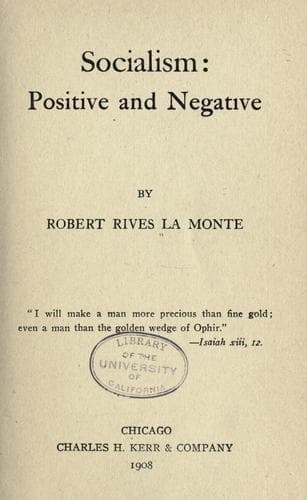
Socialism: Positive and NegativeLa Monte, Robert Rives
Philosophy
Socialism: Positive and Negative
La Monte, Robert Rives
Socialism
The socialist materialist is well content to leave this whole question
of ethics to adjust itself, since he knows that equality of condition,
the economic basis of Socialism, will necessarily evolve a mode of
living, and standards of conduct in perfect harmony with their economic
environment.
FOOTNOTES:
[5] It may be as well to state that this was written before the writer
had read Karl Kautsky's illuminating work, "Ethics and the Materialist
Conception of History."
[6] For a fuller discussion of the relation of current conceptions of
property-rights to the Natural Rights Philosophy see Veblen's "The
Theory of Business Enterprise," Chapters II and VIII, and La Monte's
paper "Veblen, The Revolutionist," International Socialist Review, Vol.
V. pp. 726-739.
THE NIHILISM OF SOCIALISM.
"In their negative proposals the socialists and anarchists are
fairly agreed. It is in the metaphysical postulates of their
protest and in their constructive aims that they part company. Of
the two, the socialists are more widely out of touch with the
established order. They are also more hopelessly negative and
destructive in their ideals, as seen from the standpoint of the
established order." THORSTEIN VEBLEN in "The Theory of Business
Enterprise." Page 338.
To label a truth a truism is too often regarded as equivalent to placing
it in the category of the negligible. It is precisely the salient
obviousness, which makes a truth a truism, that places it in the direst
peril of oblivion in the stress of modern life. Such a truth was well
stated by Enrico Ferri, the Italian criminologist, in a recent lecture
before the students of the University of Naples:
"Without an ideal, neither an individual nor a collectivity can live,
without it humanity is dead or dying. For it is the fire of an ideal
which renders the life of each one of us possible, useful and fertile.
And only by its help can each one of us, in the longer or shorter course
of his or her existence, leave behind traces for the benefit of
fellow-beings."
Platitude though this may be, our greatest poets have not hesitated to
use their highest powers to impress it upon us. Robert Browning put this
truth into the mouth of Andrea del Sarto in one of the strongest lines
in all English verse,
"Ah, but a man's reach should exceed his grasp."
Public-domain text, read in full here on John Shaqi.
Reviews
Reviews
No reviews yet
Be the first to share your thoughts on this work.
Join the Discussion
Join the discussion
Sign in to leave a comment or review.
Sign InorCreate an account