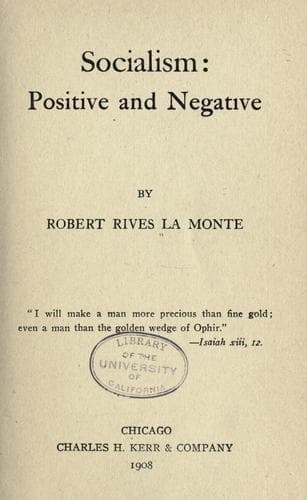
Socialism: Positive and NegativeLa Monte, Robert Rives
Philosophy
Socialism: Positive and Negative
La Monte, Robert Rives
Socialism
Mr. George S. Street, in a very interesting paper in Putnam's Monthly
for November (1906), points out that the most significant contrast
between our time and Early Victorian days is a decrease in idealism.
"The most characteristic note," he tells us, "in the mental attitude of
the forties and fifties in England, and that in which they contrast most
sharply with our own times, was confidence.... In party politics this
confidence was almost without limit. There was a section of Conservatism
which really believed in things as they were, and thought it undesirable
to attempt any change for the better.... It was simply--I speak of a
section, not the party as a whole--the articulate emotion of privileged
and contented people and their parasites, and its denomination as
'stupid' was an accurate description, though hardly the brilliant
epigram for which, in our poverty of political wit, it has been taken.
On the other hand, there was a confident Liberalism which inspired a
whole party. Some wished to go faster, some slower, but all believed
sincerely in a broad scheme of domestic policy. They were to reform this
and that at home; they were to assist, or at least applaud, the
reforming of this and that abroad. So believing and intending, they
naturally conceived themselves made very little indeed lower than the
angels.
"The contrast with our own day hardly needs pointing. You might now
search long and in vain for a Conservative in public life who would not
admit that reforms are desirable or even urgent, though few might be
prepared with precise statements about particulars.... But their (the
Liberals') confidence in reform, in their ability to improve the body
politic by certain definite measures, is gone. The old Liberal spirit
animating a whole party is dead. It may seem an odd remark to make just
after the late election, but the evidence is abundant, and the
explanation simple. Domestic reform on a large scale and on
individualist lines has reached its limit; but to many Liberals, to many
eminent and authoritative Liberals, reform on socialist lines is
abhorrent.... Consequently there is a large party called Liberal, which,
through the faults of its opponents and the accidents of time, is
successful and has the high spirits of success, but is no more now than
it has been for twenty years a party of homogeneous confidence in
domestic reform, while on the world outside the British islands it looks
with passivity, perhaps timidity, certainly with no intention of
assisting oppressed peoples."
* * * * *
"Theoretical Socialism of a logical and thoughtful kind, not entangled
with Radicalism, has made much progress of late years, more especially,
so far as my own experience goes, in the educated and professional
classes; but in practice it bides its time, with confidence perhaps, but
with a consciousness that the time will be long coming. That is a
different spirit from the buoyant expectancy of the old Liberalism."
Public-domain text, read in full here on John Shaqi.
Reviews
Reviews
No reviews yet
Be the first to share your thoughts on this work.
Join the Discussion
Join the discussion
Sign in to leave a comment or review.
Sign InorCreate an account