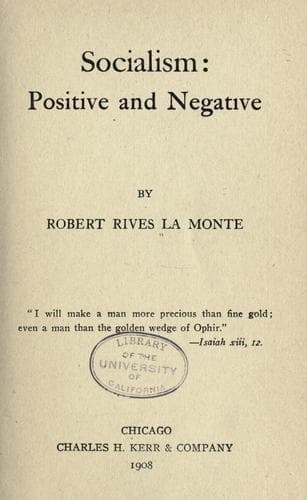
Socialism: Positive and NegativeLa Monte, Robert Rives
Philosophy
Socialism: Positive and Negative
La Monte, Robert Rives
Socialism
Religions, schools of ethics, philosophy, metaphysics, art, political
and juridical institutions are all to be explained in the last analysis
by the economic and telluric environments, present and past. This
ruthless materialism crushes belief in God, in the Soul, in immortality.
It leaves no room for any shred of dualism in thought. It is true that
the German Social Democracy included in the famous Erfurt Programme
(adopted in 1891--the first clearly Marxian socialist platform ever
promulgated) a demand for a "Declaration that religion is a private
matter. Abolition of all expenditure from public funds upon
ecclesiastical and religious objects. Ecclesiastical and religious
bodies are to be regarded as private associations, which order their
affairs independently." It will be seen that this is nothing more than a
demand that the State withdraw its sanction of religion as France has
recently done in the Clemenceau law. But Ferri does nothing but draw the
necessary conclusions from socialist premises when he writes: "God, as
Laplace has said, is an hypothesis of which exact science has no need;
he is, according to Herzen, at the most an X, which represents not the
_unknowable_--as Spencer and Dubois Raymond contend--but all that which
humanity does not yet know. Therefore, it is a variable X which
decreases in direct ratio to the progress of the discoveries of science.
"It is for this reason that science and religion are in inverse ratio to
each other; the one diminishes and grows weaker in the same proportion
that the other increases and grows stronger in its struggle against the
unknown."[14]
Joseph Dietzgen has thus stated what may be called the law of the
atrophy of religion: "The more the idea of God recedes into the past the
more palpable it is; in olden times man knew everything about his God;
the more modern the form of religion has become, the more confused and
hazy are our religious ideas. The truth is that the historic
development of religion tends to its gradual dissolution."[15]
The characteristic attitude of the socialist materialist toward
Christianity appears very clearly in the following excerpt from
Professor Ferri's "Socialism and Modern Science":
"It is true that Marxian Socialism, since the Congress held at Erfurt
(1891), has rightly declared that religious beliefs are private
affairs[16] and that, therefore, the Socialist party combats religious
intolerance under all its forms.... But this breadth of superiority of
view is, at bottom, only a consequence of the confidence in final
victory.
Public-domain text, read in full here on John Shaqi.
Reviews
Reviews
No reviews yet
Be the first to share your thoughts on this work.
Join the Discussion
Join the discussion
Sign in to leave a comment or review.
Sign InorCreate an account