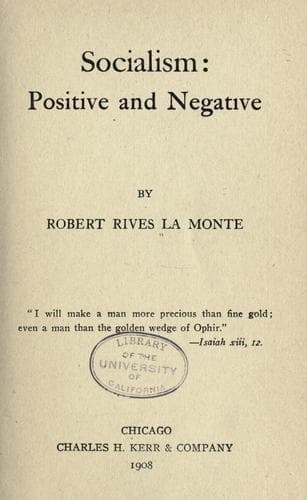
Socialism: Positive and NegativeLa Monte, Robert Rives
Philosophy
Socialism: Positive and Negative
La Monte, Robert Rives
Socialism
"It is because Socialism knows and foresees that religious beliefs,
whether one regards them, with Sergi, as pathological phenomena of human
psychology, or as useless phenomena of moral incrustation, are destined
to perish by atrophy with the extension of even elementary scientific
culture. This is why Socialism does not feel the necessity of waging a
special warfare against these religious beliefs which are destined to
disappear. It has assumed this attitude, although it knows that the
absence or the impairment of the belief in God is one of the most
powerful factors for its extension, because the priests of all religions
have been, throughout all the phases of history, the most potent allies
of the ruling classes in keeping the masses pliant and submissive under
the yoke by means of the enchantment of religion, just as the tamer
keeps wild beasts submissive by the terrors of the cracks of his whip"
(page 63).
It is also well to remember that a prevalent animistic habit of thought
in viewing the events of life, whether it take the form of a belief in
luck, as in gamblers and sporting men, or the form of a belief in
supernatural interposition in mundane affairs, as in the case of the
devotees of the anthropomorphic cults, or merely the tendency to give a
teleological interpretation to evolution, to attribute a meliorative
trend to the cosmic process, as in Tennyson's "through the ages one
increasing purpose runs," tends, by retarding the prompt perception of
relations of material cause and effect, to lower the industrial
efficiency of the community.[17]
The socialist materialist can look forward with unruffled serenity to
the passing of religion, since his very definition of religion as "a
popular striving after the illusory happiness that corresponds with a
social condition which needs such an illusion,"[18] implies that it
cannot pass away till it has ceased to be needful to human happiness.
From the point of view of this Socialist materialism, the monogamous
family, the present economic unit of society, ceases to be a divine
institution, and becomes the historical product of certain definite
economic conditions. It is the form of the family peculiar to a society
based on private property in the means of production, and the production
of commodities for sale. It is not crystallized and permanent, but, like
all other institutions, fluid and subject to change. With the change in
its economic basis, the code of sexual morality and the monogamous
family are sure to be modified; but, in the judgment of such socialists
as Friedrich Engels and August Bebel, we shall probably remain
monogamous, but monogamy will cease to be compulsorily permanent.[19]
Public-domain text, read in full here on John Shaqi.
Reviews
Reviews
No reviews yet
Be the first to share your thoughts on this work.
Join the Discussion
Join the discussion
Sign in to leave a comment or review.
Sign InorCreate an account