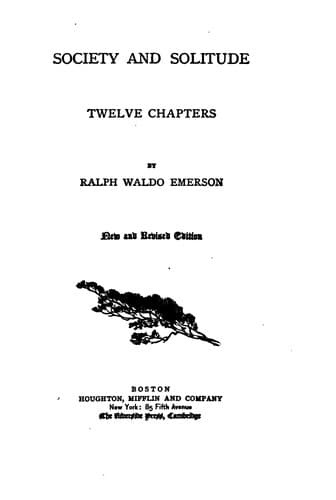
Society and solitude: Twelve chaptersEmerson, Ralph Waldo
Philosophy
Society and solitude: Twelve chapters
Emerson, Ralph Waldo
American essays -- 19th century
orator sees himself the organ of a multitude, and concentrating their
valors and powers:
“But now the blood of twenty thousand men
Blushed in my face.”
That which he wishes, that which eloquence ought to reach, is, not a
particular skill in telling a story, or neatly summing up evidence,
or arguing logically, or dexterously addressing the prejudice of the
company,--no, but a taking sovereign possession of the audience. Him
we call an artist, who shall play on an assembly of men as a master on
the keys of the piano,--who, seeing the people furious, shall soften
and compose them, shall draw them, when he will, to laughter and to
tears. Bring him to his audience, and, be they who they may,--coarse or
refined, pleased or displeased, sulky or savage, with their opinions
in the keeping of a confessor, or with their opinions in their
bank-safes,--he will have them pleased and humored as he chooses; and
they shall carry and execute that which he bids them.
This is that despotism which poets have celebrated in the “Pied Piper
of Hamelin,” whose music drew like the power of gravitation,--drew
soldiers and priests, traders and feasters, women and boys, rats and
mice; or that of the minstrel of Meudon, who made the pall-bearers
dance around the bier. This is a power of many degrees, and requiring
in the orator a great range of faculty and experience, requiring a
large composite man, such as Nature rarely organizes; so that, in our
experience, we are forced to gather up the figure in fragments, here
one talent, and there another.
Public-domain text, read in full here on John Shaqi.
Reviews
Reviews
No reviews yet
Be the first to share your thoughts on this work.
Join the Discussion
Join the discussion
Sign in to leave a comment or review.
Sign InorCreate an account