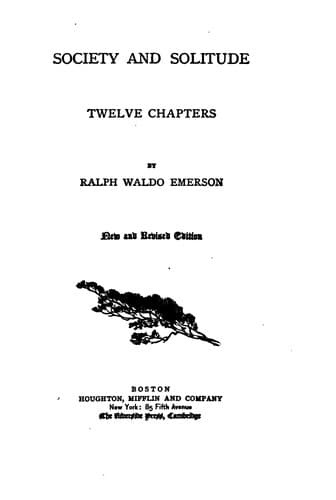
Society and solitude: Twelve chaptersEmerson, Ralph Waldo
Philosophy
Society and solitude: Twelve chapters
Emerson, Ralph Waldo
American essays -- 19th century
The audience is a constant metre of the orator. There are many
audiences in every public assembly, each one of which rules in turn.
If anything comic and coarse is spoken, you shall see the emergence
of the boys and rowdies, so loud and vivacious that you might think
the house was filled with them. If new topics are started, graver and
higher, these roisters recede; a more chaste and wise attention takes
place. You would think the boys slept, and that the men have any degree
of profoundness. If the speaker utter a noble sentiment, the attention
deepens, a new and highest audience now listens, and the audiences
of the fun and of facts and of the understanding are all silenced
and awed. There is also something excellent in every audience,--the
capacity of virtue. They are ready to be beatified. They know so much
more than the orator,--and are so just! There is a tablet there for
every line he can inscribe, though he should mount to the highest
levels. Humble persons are conscious of new illumination; narrow brows
expand with enlarged affections;--delicate spirits, long unknown to
themselves, masked and muffled in coarsest fortunes, who now hear their
own native language for the first time, and leap to hear it. But all
these several audiences, each above each, which successively appear to
greet the variety of style and topic, are really composed out of the
same persons; nay, sometimes the same individual will take active part
in them all, in turn.
This range of many powers in the consummate speaker, and of many
audiences in one assembly, leads us to consider the successive stages
of oratory.
Perhaps it is the lowest of the qualities of an orator, but it is, on
so many occasions, of chief importance,--a certain robust and radiant
physical health; or,--shall I say?--great volumes of animal heat. When
each auditor feels himself to make too large a part of the assembly,
and shudders with cold at the thinness of the morning audience, and
with fear lest all will heavily fail through one bad speech, mere
energy and mellowness are then inestimable. Wisdom and learning would
be harsh and unwelcome, compared with a substantial cordial man, made
of milk, as we say, who is a house-warmer, with his obvious honesty
and good meaning, and a hue-and-cry style of harangue, which inundates
the assembly with a flood of animal spirits, and makes all safe and
secure, so that any and every sort of good speaking becomes at once
practicable. I do not rate this animal eloquence very highly; and yet,
as we must be fed and warmed before we can do any work well,--even the
best,--so is this semi-animal exuberance, like a good stove, of the
first necessity in a cold house.
Public-domain text, read in full here on John Shaqi.
Reviews
Reviews
No reviews yet
Be the first to share your thoughts on this work.
Join the Discussion
Join the discussion
Sign in to leave a comment or review.
Sign InorCreate an account