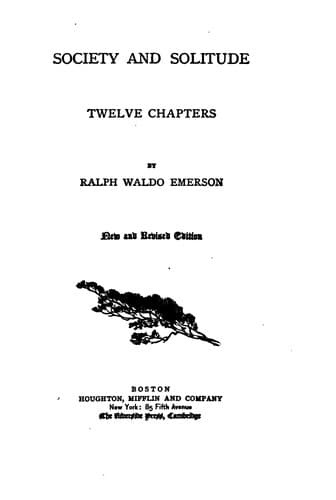
Society and solitude: Twelve chapters — John Shaqi
Society and solitude: Twelve chaptersEmerson, Ralph Waldo
Philosophy
Society and solitude: Twelve chapters
Emerson, Ralph Waldo
American essays -- 19th century
Climate has much to do with it,--climate and race. Set a New-Englander
to describe any accident which happened in his presence. What
hesitation and reserve in his narrative! He tells with difficulty some
particulars, and gets as fast as he can to the result, and, though he
cannot describe, hopes to suggest the whole scene. Now listen to a
poor Irishwoman recounting some experience of hers. Her speech flows
like a river,--so unconsidered, so humorous, so pathetic, such justice
done to all the parts! It is a true transubstantiation,--the fact
converted into speech, all warm and colored and alive, as it fell out.
Our Southern people are almost all speakers, and have every advantage
over the New England people, whose climate is so cold that, ’tis said,
we do not like to open our mouths very wide. But neither can the
Southerner in the United States, nor the Irish, compare with the lively
inhabitant of the south of Europe. The traveller in Sicily needs no
gayer melodramatic exhibition than the _table d’hôte_ of his inn will
afford him in the conversation of the joyous guests. They mimic the
voice and manner of the person they describe; they crow, squeal, hiss,
cackle, bark, and scream like mad, and, were it only by the physical
strength exerted in telling the story, keep the table in unbounded
excitement. But in every constitution some large degree of animal vigor
is necessary as material foundation for the higher qualities of the art.
But eloquence must be attractive, or it is none. The virtue of books
is, to be readable, and of orators, to be interesting; and this is
a gift of Nature; as Demosthenes, the most laborious student in
that kind, signified his sense of this necessity when he wrote,
“Good Fortune,” as his motto on his shield. As we know, the power of
discourse of certain individuals amounts to fascination, though it may
have no lasting effect. Some portion of this sugar must intermingle.
The right eloquence needs no bell to call the people together, and no
constable to keep them. It draws the children from their play, the
old from their arm-chairs, the invalid from his warm chamber: it holds
the hearer fast; steals away his feet, that he shall not depart,--his
memory, that he shall not remember the most pressing affairs,--his
belief, that he shall not admit any opposing considerations. The
pictures we have of it in semi-barbarous ages, when it has some
advantages in the simpler habit of the people, show what it aims at. It
is said that the Khans, or story-tellers, in Ispahan and other cities
of the East, attain a controlling power over their audience, keeping
them for many hours attentive to the most fanciful and extravagant
adventures. The whole world knows pretty well the style of these
improvisators, and how fascinating they are, in our translations of the
“Arabian Nights.” Scheherezade tells these stories to save her life,
and the delight of young Europe and young America in them proves that
she fairly earned it.
Public-domain text, read in full here on John Shaqi.
Reviews
Reviews
No reviews yet
Be the first to share your thoughts on this work.
Join the Discussion
Join the discussion
Sign in to leave a comment or review.
Sign InorCreate an account