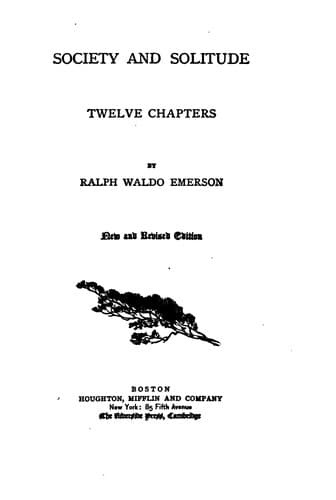
Society and solitude: Twelve chaptersEmerson, Ralph Waldo
Philosophy
Society and solitude: Twelve chapters
Emerson, Ralph Waldo
American essays -- 19th century
Next to the knowledge of the fact and its law is method, which
constitutes the genius and efficiency of all remarkable men. A crowd
of men go up to Faneuil Hall; they are all pretty well acquainted with
the object of the meeting; they have all read the facts in the same
newspapers. The orator possesses no information which his hearers have
not; yet he teaches them to see the thing with his eyes. By the new
placing, the circumstances acquire new solidity and worth. Every fact
gains consequence by his naming it, and trifles become important. His
expressions fix themselves in men’s memories, and fly from mouth to
mouth. His mind has some new principle of order. Where he looks, all
things fly into their places. What will he say next? Let this man
speak, and this man only. By applying the habits of a higher style of
thought to the common affairs of this world, he introduces beauty and
magnificence wherever he goes. Such a power was Burke’s, and of this
genius we have had some brilliant examples in our own political and
legal men.
Imagery. The orator must be, to a certain extent, a poet. We are
such imaginative creatures, that nothing so works on the human mind,
barbarous or civil, as a trope. Condense some daily experience into a
glowing symbol, and an audience is electrified. They feel as if they
already possessed some new right and power over a fact, which they can
detach, and so completely master in thought. It is a wonderful aid to
the memory, which carries away the image, and never loses it. A popular
assembly, like the House of Commons, or the French Chamber, or the
American Congress, is commanded by these two powers,--first by a fact,
then by skill of statement. Put the argument into a concrete shape,
into an image,--some hard phrase, round and solid as a ball, which they
can see and handle and carry home with them,--and the cause is half
won.
Public-domain text, read in full here on John Shaqi.
Reviews
Reviews
No reviews yet
Be the first to share your thoughts on this work.
Join the Discussion
Join the discussion
Sign in to leave a comment or review.
Sign InorCreate an account