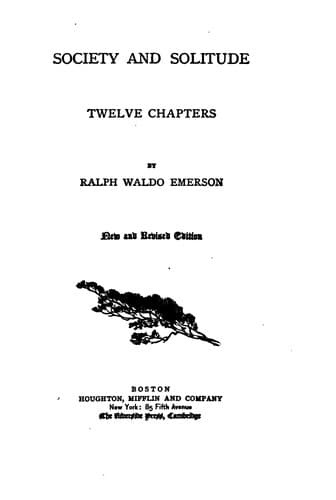
Society and solitude: Twelve chapters — John Shaqi
Society and solitude: Twelve chaptersEmerson, Ralph Waldo
Philosophy
Society and solitude: Twelve chapters
Emerson, Ralph Waldo
American essays -- 19th century
Statement, method, imagery, selection, tenacity of memory, power of
dealing with facts, of illuminating them, of sinking them by ridicule
or by diversion of the mind, rapid generalization, humor, pathos,
are keys which the orator holds; and yet these fine gifts are not
eloquence, and do often hinder a man’s attainment of it. And if we
come to the heart of the mystery, perhaps we should say that the truly
eloquent man is a sane man with power to communicate his sanity. If
you arm the man with the extraordinary weapons of this art, give him
a grasp of facts, learning, quick fancy, sarcasm, splendid allusion,
interminable illustration,--all these talents, so potent and charming,
have an equal power to insnare and mislead the audience and the orator.
His talents are too much for him, his horses run away with him; and
people always perceive whether you drive, or whether the horses take
the bits in their teeth and run. But these talents are quite something
else when they are subordinated and serve him; and we go to Washington,
or to Westminster Hall, or might well go round the world, to see a
man who drives, and is not run away with,--a man who, in prosecuting
great designs, has an absolute command of the means of representing his
ideas, and uses them only to express these; placing facts, placing men;
amid the inconceivable levity of human beings, never for an instant
warped from his erectness. There is for every man a statement possible
of that truth which he is most unwilling to receive,--a statement
possible, so broad and so pungent that he cannot get away from it, but
must either bend to it or die of it. Else there would be no such word
as eloquence, which means this. The listener cannot hide from himself
that something has been shown him and the whole world, which he did
not wish to see; and, as he cannot dispose of it, it disposes of him.
The history of public men and affairs in America will readily furnish
tragic examples of this fatal force.
Public-domain text, read in full here on John Shaqi.
Reviews
Reviews
No reviews yet
Be the first to share your thoughts on this work.
Join the Discussion
Join the discussion
Sign in to leave a comment or review.
Sign InorCreate an account