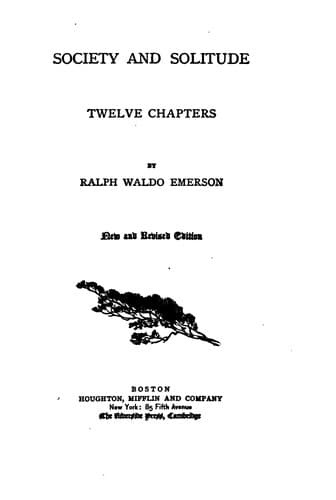
Society and solitude: Twelve chaptersEmerson, Ralph Waldo
Philosophy
Society and solitude: Twelve chapters
Emerson, Ralph Waldo
American essays -- 19th century
Here again, as so often, Nature delights to put us between extreme
antagonisms, and our safety is in the skill with which we keep the
diagonal line. Solitude is impracticable, and society fatal. We must
keep our head in the one and our hands in the other. The conditions are
met, if we keep our independence, yet do not lose our sympathy. These
wonderful horses need to be driven by fine hands. We require such a
solitude as shall hold us to its revelations when we are in the street
and in palaces; for most men are cowed in society, and say good things
to you in private, but will not stand to them in public. But let us
not be the victims of words. Society and solitude are deceptive names.
It is not the circumstance of seeing more or fewer people, but the
readiness of sympathy, that imports; and a sound mind will derive its
principles from insight, with ever a purer ascent to the sufficient and
absolute right, and will accept society as the natural element in which
they are to be applied.
CIVILIZATION.
CIVILIZATION.
A certain degree of progress from the rudest state in which man is
found,--a dweller in caves, or on trees, like an ape,--a cannibal,
and eater of pounded snails, worms, and offal,--a certain degree of
progress from this extreme is called Civilization. It is a vague,
complex name, of many degrees. Nobody has attempted a definition.
Mr. Guizot, writing a book on the subject, does not. It implies the
evolution of a highly organized man, brought to supreme delicacy of
sentiment, as in practical power, religion, liberty, sense of honor,
and taste. In the hesitation to define what it is, we usually suggest
it by negations. A nation that has no clothing, no iron, no alphabet,
no marriage, no arts of peace, no abstract thought, we call barbarous.
And after many arts are invented or imported, as among the Turks
and Moorish nations, it is often a little complaisant to call them
civilized.
Public-domain text, read in full here on John Shaqi.
Reviews
Reviews
No reviews yet
Be the first to share your thoughts on this work.
Join the Discussion
Join the discussion
Sign in to leave a comment or review.
Sign InorCreate an account