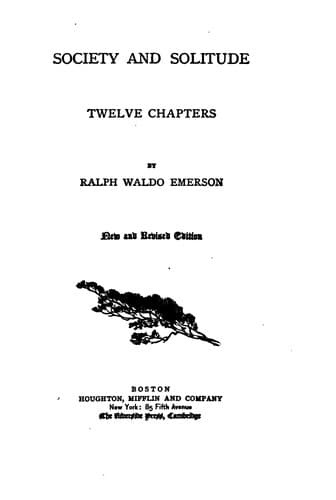
Society and solitude: Twelve chaptersEmerson, Ralph Waldo
Philosophy
Society and solitude: Twelve chapters
Emerson, Ralph Waldo
American essays -- 19th century
Each nation grows after its own genius, and has a civilization of its
own. The Chinese and Japanese, though each complete in his way, is
different from the man of Madrid or the man of New York. The term
imports a mysterious progress. In the brutes is none; and in mankind
to-day the savage tribes are gradually extinguished rather than
civilized. The Indians of this country have not learned the white man’s
work; and in Africa, the negro of to-day is the negro of Herodotus.
In other races the growth is not arrested; but the like progress that
is made by a boy “when he cuts his eye-teeth,” as we say,--childish
illusions passing daily away, and he seeing things really and
comprehensively,--is made by tribes. It is the learning the secret of
cumulative power, of advancing on one’s self. It implies a facility
of association, power to compare, the ceasing from fixed ideas. The
Indian is gloomy and distressed when urged to depart from his habits
and traditions. He is overpowered by the gaze of the white, and his eye
sinks. The occasion of one of these starts of growth is always some
novelty that astounds the mind, and provokes it to dare to change. Thus
there is a Cadmus, a Pytheas, a Manco Capac at the beginning of each
improvement,--some superior foreigner importing new and wonderful arts,
and teaching them. Of course, he must not know too much, but must have
the sympathy, language, and gods of those he would inform. But chiefly
the sea-shore has been the point of departure to knowledge, as to
commerce. The most advanced nations are always those who navigate the
most. The power which the sea requires in the sailor makes a man of him
very fast, and the change of shores and population clears his head of
much nonsense of his wigwam.
Where shall we begin or end the list of those feats of liberty and
wit, each of which feats made an epoch of history? Thus, the effect
of a framed or stone house is immense on the tranquillity, power, and
refinement of the builder. A man in a cave or in a camp, a nomad,
will die with no more estate than the wolf or the horse leaves. But
so simple a labor as a house being achieved, his chief enemies are
kept at bay. He is safe from the teeth of wild animals, from frost,
sun-stroke, and weather; and fine faculties begin to yield their fine
harvest. Invention and art are born, manners and social beauty and
delight. ’Tis wonderful how soon a piano gets into a log-hut on the
frontier. You would think they found it under a pine-stump. With it
comes a Latin grammar,--and one of those tow-head boys has written a
hymn on Sunday. Now let colleges, now let senates take heed! for here
is one who, opening these fine tastes on the basis of the pioneer’s
iron constitution, will gather all their laurels in his strong hands.
Public-domain text, read in full here on John Shaqi.
Reviews
Reviews
No reviews yet
Be the first to share your thoughts on this work.
Join the Discussion
Join the discussion
Sign in to leave a comment or review.
Sign InorCreate an account