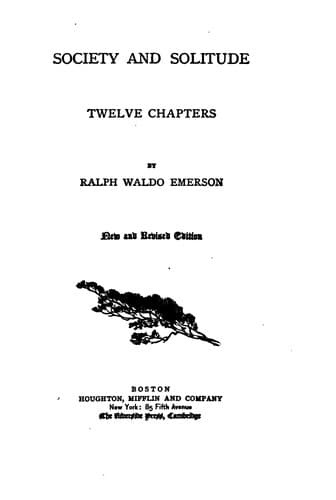
Society and solitude: Twelve chaptersEmerson, Ralph Waldo
Philosophy
Society and solitude: Twelve chapters
Emerson, Ralph Waldo
American essays -- 19th century
Nature is much our friend in this matter. Nature is always clarifying
her water and her wine. No filtration can be so perfect. She does the
same thing by books as by her gases and plants. There is always a
selection in writers, and then a selection from the selection. In the
first place, all books that get fairly into the vital air of the world
were written by the successful class, by the affirming and advancing
class, who utter what tens of thousands feel though they cannot say.
There has already been a scrutiny and choice from many hundreds of
young pens, before the pamphlet or political chapter which you read in
a fugitive journal comes to your eye. All these are young adventurers,
who produce their performance to the wise ear of Time, who sits and
weighs, and, ten years hence, out of a million of pages reprints
one. Again it is judged, it is winnowed by all the winds of opinion,
and what terrific selection has not passed on it before it can be
reprinted after twenty years,--and reprinted after a century!--it is as
if Minos and Rhadamanthus had indorsed the writing. ’Tis therefore an
economy of time to read old and famed books. Nothing can be preserved
which is not good; and I know beforehand that Pindar, Martial, Terence,
Galen, Kepler, Galileo, Bacon, Erasmus, More, will be superior to the
average intellect. In contemporaries, it is not so easy to distinguish
betwixt notoriety and fame.
Be sure, then, to read no mean books. Shun the spawn of the press on
the gossip of the hour. Do not read what you shall learn, without
asking, in the street and the train. Dr. Johnson said, “he always went
into stately shops”; and good travellers stop at the best hotels; for,
though they cost more, they do not cost much more, and there is the
good company and the best information. In like manner, the scholar
knows that the famed books contain, first and last, the best thoughts
and facts. Now and then, by rarest luck, in some foolish Grub Street
is the gem we want. But in the best circles is the best information.
If you should transfer the amount of your reading day by day from the
newspaper to the standard authors---- But who dare speak of such a
thing?
The three practical rules, then, which I have to offer, are,--1. Never
read any book that is not a year old. 2. Never read any but famed
books. 3. Never read any but what you like; or, in Shakspeare’s phrase
“No profit goes where is no pleasure ta’en:
In brief, sir, study what you most affect.”
Montaigne says, “Books are a languid pleasure”; but I find certain
books vital and spermatic, not leaving the reader what he was: he shuts
the book a richer man. I would never willingly read any others than
such. And I will venture, at the risk of inditing a list of old primers
and grammars, to count the few books which a superficial reader must
thankfully use.
Public-domain text, read in full here on John Shaqi.
Reviews
Reviews
No reviews yet
Be the first to share your thoughts on this work.
Elsewhere in the archive
Join the Discussion
Join the discussion
Sign in to leave a comment or review.
Sign InorCreate an account