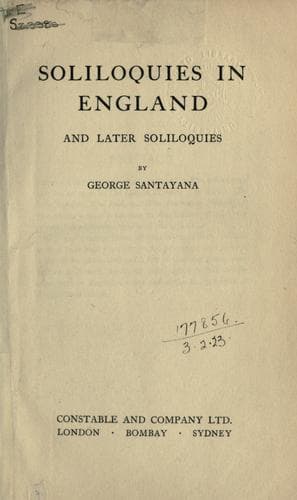
Soliloquies in England, and Later SoliloquiesSantayana, George
Philosophy
Soliloquies in England, and Later Soliloquies
Santayana, George
American essays -- 20th century
at least the poet in his soliloquy has uttered his mind and raised his
monument in his own eyes; and in expressing his life he has found it.
33
THE COMIC MASK
The down is the primitive comedian. Sometimes in the exuberance of
animal life a spirit of riot and frolic comes over a man; he leaps,
he dances, he tumbles head over heels, he grins, shouts, or leers,
possibly he pretends to go to pieces suddenly, and blubbers like a
child. A moment later he may look up wreathed in smiles, and hugely
pleased about nothing. All this he does hysterically, without any
reason, by a sort of mad inspiration and irresistible impulse. He
may easily, however, turn his absolute histrionic impulse, his pure
fooling, into mimicry of anything or anybody that at the moment happens
to impress his senses; he will crow like a cock, simper like a young
lady, or reel like a drunkard. Such mimicry is virtual mockery, because
the actor is able to revert from those assumed attitudes to his natural
self; whilst his models, as he thinks, have no natural self save
that imitable attitude, and can never disown it; so that the clown
feels himself immensely superior, in his rôle of universal satirist,
to all actual men, and belabours and rails at them unmercifully. He
sees everything in caricature, because he sees the surface only, with
the lucid innocence of a child; and all these grotesque personages
stimulate him, not to moral sympathy, nor to any consideration of
their fate, but rather to boisterous sallies, as the rush of a crowd,
or the hue and cry of a hunt, or the contortions of a jumping-jack
might stimulate him. He is not at all amused intellectually; he is
not rendered wiser or tenderer by knowing the predicaments into which
people inevitably fall; he is merely excited, flushed, and challenged
by an absurd spectacle. Of course this rush and suasion of mere
existence must never fail on the stage, nor in any art; it is to the
drama what the hypnotizing stone block is to the statue, or shouts and
rhythmic breathing to the bard; but such primary magical influences may
be qualified by reflection, and then rational and semi-tragic unities
will supervene. When this happens the histrionic impulse creates the
idyl or the tragic chorus; henceforth the muse of reflection follows
in the train of Dionysus, and the revel or the rude farce passes into
humane comedy.
Public-domain text, read in full here on John Shaqi.
Reviews
Reviews
No reviews yet
Be the first to share your thoughts on this work.
Elsewhere in the archive
Join the Discussion
Join the discussion
Sign in to leave a comment or review.
Sign InorCreate an account