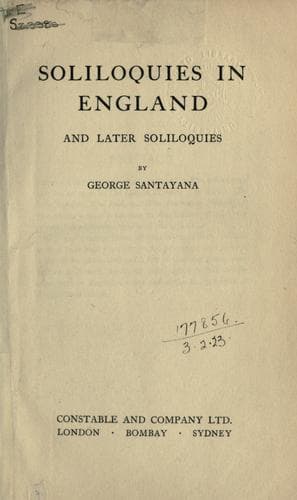
Soliloquies in England, and Later SoliloquiesSantayana, George
Philosophy
Soliloquies in England, and Later Soliloquies
Santayana, George
American essays -- 20th century
Modern reformers, religious and political, have usually retained
the classic theory of orthodoxy, namely, that there is one right or
true system--democracy and free thought, for instance--which it is
the reformer's duty to establish in the place of prevalent abuses.
Certainly Luther and Calvin and the doctrinaires of the French
revolution only meant to substitute one orthodoxy for another, and
what they set forth they regarded as valid for all men and forever.
Nevertheless they had a greater success in discrediting the received
system than in establishing their own, and the general effect of their
reforms was to introduce the modern conception of liberty, the liberty
of liberalism.
This consists in limiting the prescriptions of the law to a few points,
for the most part negative, leaving it to the initiative and conscience
of individuals to order their life and conversation as they like,
provided only they do not interfere with the same freedom in others. In
practice liberal countries have never reached this ideal of peaceful
anarchy, but have continued to enforce state education, monogamy, the
vested rights of property, and sometimes military service. But within
whatever limits, liberty is understood to lie in the individual being
left alone, so that he may express his personal impulses as he pleases
in word and action.
A philosopher can readily see that this liberal ideal implies a certain
view about the relations of man in the universe. It implies that the
ultimate environment, divine or natural, is either chaotic in itself or
undiscoverable by human science, and that human nature, too, is either
radically various or only determinable in a few essentials, round which
individual variations play _ad libitum_. For this reason no normal
religion, science, art, or way of happiness can be prescribed. These
remain always open, even in their foundations, for each man to arrange
for himself. The more things are essentially unsettled and optional,
the more liberty of this sort there may safely be in the world and the
deeper it may run.
Public-domain text, read in full here on John Shaqi.
Reviews
Reviews
No reviews yet
Be the first to share your thoughts on this work.
Elsewhere in the archive
Join the Discussion
Join the discussion
Sign in to leave a comment or review.
Sign InorCreate an account