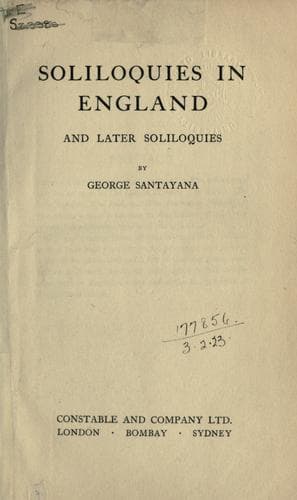
Soliloquies in England, and Later SoliloquiesSantayana, George
Philosophy
Soliloquies in England, and Later Soliloquies
Santayana, George
American essays -- 20th century
Man, however, is a gregarious animal, and much more so in his mind
than in his body. He may like to go alone for a walk, but hates to
stand alone in his opinions. And he is so imitative that what he thinks
he most wishes to do is whatever he sees other people doing. Hence
if compulsory organization disappears a thousand free and private
organizations at once take its place. Virginal lived in compulsory
unison, having only one unquestioned religion, one style of art, one
political order, one common spring of laughter and tears. Liberalism
has come to remove the strain and the trammels of these traditions
without as yet uprooting the traditions themselves. Most people retain
their preliberal heritage and hardly remember that they are legally
free to abandon it and to sample any and every other form of life.
Liberalism does not go very deep; it is an adventitious principle, a
mere loosening of an older structure. For that reason it brings to all
who felt cramped and ill-suited such comfort and relief. It offers them
an escape from all sorts of accidental tyrannies. It opens to them that
sweet, scholarly, tenderly moral, critically superior attitude of mind
which Matthew Arnold called culture.
Primitive, dragooned, unanimous ages cannot possess culture. What
they possess is what the Germans call a _Kultur_, some type or other
of manners, laws, implements, arts, religion. When these national
possessions are perused and relished by some individual who does
not take them for granted and who understands and judges them as if
from outside, his acquaintance with them becomes an element in his
culture; and if he is at home in many such forms of life and thought,
his culture is the more perfect. It should ideally be culled from
everywhere. Culture is a triumph of the individual over society. It is
his way of profiting intellectually by a world he has not helped to
make.
Culture requires liberalism for its foundation, and liberalism requires
culture for its crown. It is culture that integrates in imagination
the activities which liberalism so dangerously disperses in practice.
Out of the public disarray of beliefs and efforts it gathers its
private collection of curiosities, much as amateurs stock their museums
with fragments of ancient works. It possesses a wealth of vicarious
experience and historical insight which comforts it for having nothing
of its own to contribute to history. The man of culture abounds in
discriminating sentiments; he lives under the distant influence
of exalted minds; his familiar thoughts at breakfast are intimate
appreciations of poetry and art, and if his culture is really mellow,
he sometimes smiles a little at his own culture.
Public-domain text, read in full here on John Shaqi.
Reviews
Reviews
No reviews yet
Be the first to share your thoughts on this work.
Elsewhere in the archive
Join the Discussion
Join the discussion
Sign in to leave a comment or review.
Sign InorCreate an account