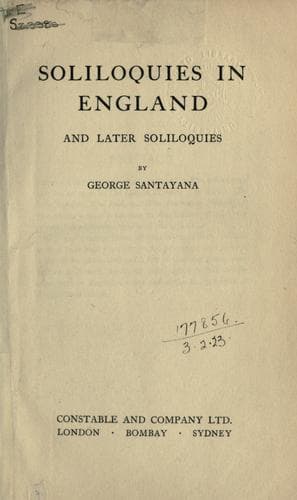
Soliloquies in England, and Later SoliloquiesSantayana, George
Philosophy
Soliloquies in England, and Later Soliloquies
Santayana, George
American essays -- 20th century
Culture came into the modern world with the renaissance, when personal
humours and remote inspiration broke in upon the consecrated mediaeval
mind. Piety and learning had their intrinsic charms, but, after all,
they had been cultivated for the sake of ulterior duties and benefits,
and in order to appropriate and hand down the revealed wisdom which
opened the way to heaven. Culture, on the contrary, had no ulterior
purpose, no forced unity. It was an aroma inhaled by those who walked
in the evening in the garden of life. Far from being a means to
religion, it threw religion also into the context of human experience,
and touched its mysteries and quarrels with judgement and elegance. It
liberated the studious mind from obligatory or national discipline,
and as far as possible from all bonds of time, place, utility, and
co-operation, kindling sympathies by preference with what was most
exotic, and compensating the mind for the ignominious necessity of
having to be, in practical matters, local and partisan. Culture was
courteous, open, unconscious of self; it was the joy of living every
life but one's own. And its moral side--for everything has its moral
side--lay in the just judgements it fostered, the clear sense it
awakened of the different qualities and values of things. The scale of
values established by the man of culture might sometimes be fanciful or
frivolous, but he was always most scrupulous, according to his lights,
in distinguishing the better from the worse. This conscientiousness,
after all, is the only form of morality that a liberal society can
insist upon.
The days of liberalism are numbered. First the horrors of competition
discredited it, and now the trial of war, which it foolishly thought
it could elude. The vogue of culture, too, has declined. We see that
the man whose success is merely personal--the actor, the sophist,
the millionaire, the aesthete--is incurably vulgar. The rightness of
liberalism is exactly proportional to the diversity of human nature,
to its vague hold on its ideals. Where this vagueness and play of
variation stop, and they stop not far below the surface, the sphere of
public organization should begin. It is in the subsoil of uniformity,
of tradition, of dire necessity that human welfare is rooted, together
with wisdom and unaffected art, and the flowers of culture that do not
draw their sap from that soil are only paper flowers.
43
THE IRONY OF LIBERALISM
Public-domain text, read in full here on John Shaqi.
Reviews
Reviews
No reviews yet
Be the first to share your thoughts on this work.
Elsewhere in the archive
Join the Discussion
Join the discussion
Sign in to leave a comment or review.
Sign InorCreate an account