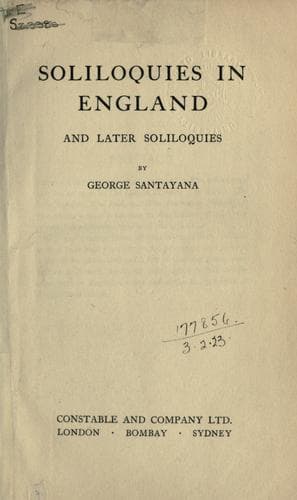
Soliloquies in England, and Later SoliloquiesSantayana, George
Philosophy
Soliloquies in England, and Later Soliloquies
Santayana, George
American essays -- 20th century
To the mind of the ancients, who knew something of such matters,
liberty and prosperity seemed hardly compatible, yet modern liberalism
wants them together. Liberals believe that free inquiry, free
invention, free association, and free trade are sure to produce
prosperity. I have no doubt they are right in this; the nineteenth
century, that golden age of liberalism, certainly saw a great increase
in wealth, in science, and in comforts. What the ancients had before
them was a different side of the question; they had no experience of
liberalism; they expected to be state-ridden in their religion, their
customs, and their military service; even in their personal and family
morals they did not begrudge the strictest discipline; their states
needed to be intensely unified, being small and in constant danger of
total destruction. Under these circumstances it seemed clear to them
that prosperity, however it might have been produced, was dangerous to
liberty. Prosperity brought power; and when a people exercises control
over other peoples its government becomes ponderous even at home;
its elaborate machinery cannot be stopped, and can hardly be mended;
the imperial people becomes the slave of its commitments. Moreover,
prosperity requires inequalities of function and creates inequalities
of fortune; and both too much work and too much wealth kill liberty
in the individual. They involve subjection to _things_; and this is
contrary to what the ancients, who had the pride of noble animals,
called freedom. Prosperity, both for individuals and for states, means
possessions; and possessions mean burdens and harness and slavery; and
slavery for the mind, too, because it is not only the rich man's time
that is pre-empted, but his affections, his judgement, and the range of
his thoughts.
I often wonder, looking at my rich friends, how far their possessions
are facilities and how far they are impediments. The telephone, for
instance, is a facility if you wish to be in many places at once and
to attend to anything that may turn up; it is an impediment if you are
happy where you are and in what you are doing. Public motor-vehicles,
public libraries, and public attendants (such as waiters in hotels,
when they wait) are a convenience, which even the impecunious may
enjoy; but private automobiles, private collections of books or
pictures, and private servants are, to my thinking, an encumbrance: but
then I am an old fogy and almost an ancient philosopher, and I don't
count. I prize civilization, being bred in towns and liking to hear and
to see what new things people are up to. I like to walk about amidst
the beautiful things that adorn the world; but private wealth I should
decline, or any sort of personal possessions, because they would take
away my liberty.
Public-domain text, read in full here on John Shaqi.
Reviews
Reviews
No reviews yet
Be the first to share your thoughts on this work.
Elsewhere in the archive
Join the Discussion
Join the discussion
Sign in to leave a comment or review.
Sign InorCreate an account