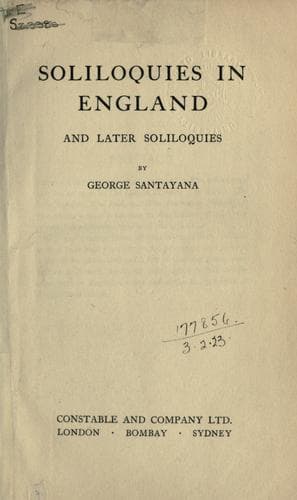
Soliloquies in England, and Later SoliloquiesSantayana, George
Philosophy
Soliloquies in England, and Later Soliloquies
Santayana, George
American essays -- 20th century
Perhaps what liberalism aspires to marry with liberty is not so much
prosperity as progress. Progress means continued change for the better;
and it is obvious that liberty will conduce to progress in all those
things, such as writing poetry, which a man can pursue without aid
or interference from others: where aid is requisite and interference
probable, as in politics, liberty conduces to progress only in so far
as people are unanimous, and spontaneously wish to move in the same
direction. Now what is the direction of change which seems progress to
liberals? A pure liberal might reply, The direction of liberty itself:
the ideal is that every man should move in whatever direction he
likes, with the aid of such as agree with him, and without interfering
with those who disagree. Liberty so conceived would be identical with
happiness, with spontaneous life, blamelessly and safely lived; and the
impulse of liberalism, to give everybody what he wants, in so far as
that is possible, would be identical with simple kindness. Benevolence
was one of the chief motives in liberalism in the beginning, and
many a liberal is still full of kindness in his private capacity;
but politically, as a liberal, he is something more than kind. The
direction in which many, or even most, people would like to move
fills him with disgust and indignation; he does not at all wish them
to be happy, unless they can be happy on his own diet; and being a
reformer and a philanthropist, he exerts himself to turn all men into
the sort of men he likes, so as to be able to like them. It would be
selfish, he thinks, to let people alone. They must be helped, and not
merely helped to what they desire--that might really be very bad for
them--but helped onwards, upwards, in the _right_ direction. Progress
could not be rightly placed in a smaller population, a simpler economy,
more moral diversity between nations, and stricter moral discipline
in each of them. That would be progress backwards, and if it made
people happier, it would not make the liberal so. Progress, if it is
to please him, must continue in the direction in which the nineteenth
century progressed, towards vast numbers, material complexity, moral
uniformity, and economic interdependence. The best little boy, for
instance, according to the liberal ideal, desires to be washed, to go
to school, to do Swedish exercises, and to learn everything out of
books. But perhaps the individual little boy (and according to the
liberal philosophy his individuality is sacred, and the only judge
of what is good or true for him is his own consciousness) desires to
go dirty, to make mud-pies in the street, and to learn everything
by experience or by report from older boys. When the philanthropist
runs up to the rescue, this little ingrate snivels at him the very
principle of liberal liberty, "Let me alone." To inform such an urchin
that he does not know what is good for him, that he is a slave to bad
Public-domain text, read in full here on John Shaqi.
Reviews
Reviews
No reviews yet
Be the first to share your thoughts on this work.
Elsewhere in the archive
Join the Discussion
Join the discussion
Sign in to leave a comment or review.
Sign InorCreate an account