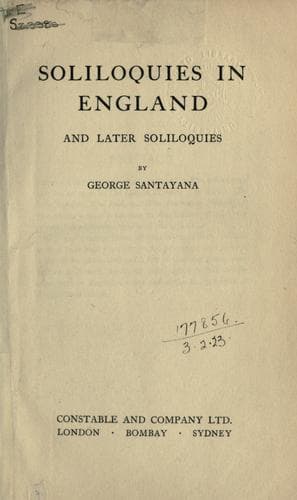
Soliloquies in England, and Later SoliloquiesSantayana, George
Philosophy
Soliloquies in England, and Later Soliloquies
Santayana, George
American essays -- 20th century
As he conceives it at first, experience does not merely exist, it
teaches. In a sporadic fashion it yields sound satisfactions, clear
warnings, plain facts. It admonishes him to trust his senses, the
reports of reputable travellers and naturalists, Christianity, and
the British constitution, all when duly revised; and on the other
hand to shun popery, scholastic quibbles, absolutism, and revolution.
But evidently experience could never teach him these things if his
inner man did not contribute its decided cravings and aversions.
His inner man detests dictation and loves opportunity; in ideas it
prefers timeliness to finality. Therefore, when his philosophers come
upon the scene they cannot appeal to him by coercive proofs, nor by
the impressive architecture of their systems, nor by disentangling
and setting clearly before him any ultimate ideal. To win his ear
they must rather drive his current convictions home, nearer to their
source in himself; they must invite him to concentrate his empiricism.
For instance, he trusts his senses; and the philosophers can deeply
interest him if they ask him what, precisely, his senses vouch for. Is
it external things? But can he actually see anything except colours,
or touch anything except resistances? Can he feel anything except his
own sensations? By appealing to his honesty, the sophists catch him
in a trap, and he changes his mind in trying to utter it. It will
appear presently, as he pursues his inquiry, that he has no knowledge
of those external things and events which he had been so sure of;
they were mere empty notions, and his genuine experience contained
nothing but the pulses of his inner life, changes in his ideas and
vital temperature, which an accurate autobiography might record. And
the more scrupulously he considers these pulses of his inner life the
less and less will he find in them. He and his whole experience will
soon be reduced to a series of sensations in single file, with nothing
behind them. In reality even this is too much. Although the inertia of
psychological conventions and the romantic habit of self-consciousness
have kept him from perceiving it, even to this day, yet the fact that
a sensation is occurring is not revealed by that sensation itself; no
date, place, or relation to a mind is included in its deliverance, and
no relation to anything before or beyond; so that the bare datum of
sensation is an aesthetic being, not a mental one; an ideal term, not
an event; a universal essence, not a particular fact; and immersion
in sense or in absolute immediate experience, when animal faith and
intelligence are taken away from it, would remove from us every vestige
of the notion that anything exists or that anything happens. But
without pushing analysis so far, the empirical philosophers left John
Bull, when he listened to them, singularly bereft of those comfortable
impedimenta with which he had expected to travel through life--without
Public-domain text, read in full here on John Shaqi.
Reviews
Reviews
No reviews yet
Be the first to share your thoughts on this work.
Elsewhere in the archive
Join the Discussion
Join the discussion
Sign in to leave a comment or review.
Sign InorCreate an account