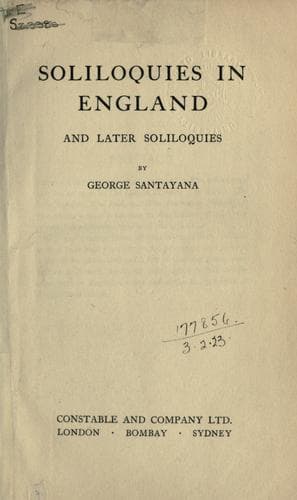
Soliloquies in England, and Later SoliloquiesSantayana, George
Philosophy
Soliloquies in England, and Later Soliloquies
Santayana, George
American essays -- 20th century
a body, without an environment, without a ground, or any natural
perfection or destiny, for his moral being. He had loved exploration,
and had looked forward with the flush of confidence to the knowledge
and power which his discoveries would bring him; but now he saw that
all discoveries were incalculable, arbitrary, and provisional, since
they were not truly discoveries, but only developments.
Here was an odd transformation. The self-educated merchants and
indignant reformers who, thumping their desks dogmatically, had
appealed so roundly to the evidence of their senses, little expected
that their philosophy was directed to turning them in the end into
inarticulate sensualists, rapt in omphalic contemplation of their
states of mind. Some academic idealists, disliking this result, which
cast a slur on the pre-eminence of spirituality and learning, and yet
not being willing or able to give up the method by which that result
had been reached, sought to push the inquiry further, and to come out
of the wood on quite the other side. My sensations, they said, since
I can now survey the whole series they form, must all exist together
in my present apprehension; and as I cannot know them except in this
single and present glance, they never can have existed out of it; so
that I am not really a series of sensations, but only the idea that
I am a series of sensations; in other words, I have become a single
sensation instead of many. To make this clearer the same philosophers
added that this single sensation or thought, which is what I really am,
is also God. Experience now turned out not to be anything that goes
on or happens or is endured; it is the theme of an immutable divine
contemplation and divine satisfaction. I am God in so far as I think
and approve; but the chequered experience which I supposed myself to be
undergoing is merely imputed to myself by God and me in our thinking.
This second conclusion, like the first, has its value for some
temperaments. It brings suddenly before us, as if it were an
accomplished fact, the innate ideal of the intellect: to see the
changing aspects of all things from above, in their true eternal
relations. But this ideal, too, is utterly disparate from that
practical experience and prevision which John Bull prizes so highly and
thinks he possesses; indeed, the sublimity of this view lies precisely
in its tendency to freeze and submerge all experience, transmuting hard
facts and anxious events into painted ships upon a painted ocean, and
for our stumbling and unfinished progress substituting a bound volume
of travels.
Public-domain text, read in full here on John Shaqi.
Reviews
Reviews
No reviews yet
Be the first to share your thoughts on this work.
Elsewhere in the archive
Join the Discussion
Join the discussion
Sign in to leave a comment or review.
Sign InorCreate an account