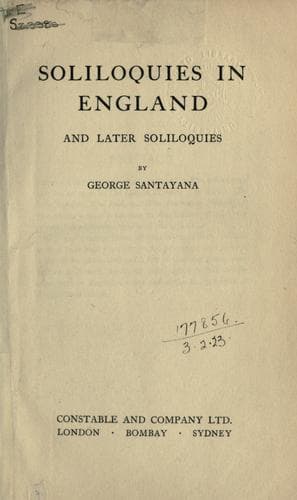
Soliloquies in England, and Later SoliloquiesSantayana, George
Philosophy
Soliloquies in England, and Later Soliloquies
Santayana, George
American essays -- 20th century
What false step could bring British philosophy, in its gropings,
to conclusions so un-English that even those who feel compelled to
propose them do so shamefacedly, with many euphemisms and convenient
confusions, or even fail altogether to understand the tremendous
paradoxes they are repeating? It was a false step at which Hobbes
halted, which Locke took unsuspectingly, and which sent Berkeley and
Hume head over heels: the assumption that facts are known immediately.
In reality none of the facts which the sturdy Briton feels that he
knows--and they are the true facts of nature and of moral life--would
be known to him if he were without tentative intelligence and
instinctive animal faith; indeed, without these the senses would have
no virtue and would inform us of nothing; and cows would not see
grass nor horses hay, but only green or yellow patches, like rapt
empirical philosophers. When Hobbes said that no discourse whatsoever
can end in absolute knowledge of fact, he uttered a great truth, but
he implied a great error, since he implied that sense--meaning the
senseless sensations of idiots--could give such knowledge; whereas
the absolute datum in sense is just as ideal, and just as little
a fact, as the deliverance of the most theoretical discourse; and
absolute knowledge--if we call such apprehension knowledge--can seize
only some aesthetic or logical term, without any given date, place,
or connection in experience. Empiricism in the end must substitute
these ideal essences, on the ground that they are the only data, for
the facts of nature--facts which animal reactions and the beliefs
expressing them are requisite to discover, and which science defines by
the cumulative use of reason. In making this substitution empiricism
passes against its will into sensualism or idealism. Then John Bull
and his philosophers part company: he sticks manfully to his confused
conventional opinions, which after all give him a very tolerable
knowledge of the facts; while they go digging for an absolute knowledge
of fact, which is impossible, in an intuitive cloudland where there
are only aesthetic essences. Hence the bankruptcy of their enterprise.
Immediate data are the counters of experience, but they are the money
of empiricism.
45
OCCAM'S RAZOR
Public-domain text, read in full here on John Shaqi.
Reviews
Reviews
No reviews yet
Be the first to share your thoughts on this work.
Elsewhere in the archive
Join the Discussion
Join the discussion
Sign in to leave a comment or review.
Sign InorCreate an account