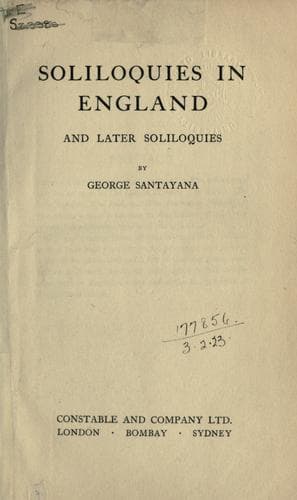
Soliloquies in England, and Later SoliloquiesSantayana, George
Philosophy
Soliloquies in England, and Later Soliloquies
Santayana, George
American essays -- 20th century
To many an Englishman the human head seems too luxuriant. With its
quantities of superfluous words and ideas, it grows periodically hot
and messy, and needs a thorough cropping and scrubbing. To this end,
William of Occam long ago invented his razor: _entia non multiplicanda
praeter necessitatem_; a maxim calculated to shave the British inner
man clean, and make a roundhead of him, not to say a blockhead. That
everything is "nothing but" something else, probably inferior to it,
became in time a sort of refrain in his politics and philosophy. He
saw that reflection was constantly embroidering on the facts; but did
he suppose that the pattern of things was really simpler than that of
ideas, or did he feel that, however elaborate things might be, thought
at least might be simple? At any rate, he aimed instinctively at
economy of terms, retrenchment in belief, reduction of theory to the
irreducible minimum. If theory was not useful, what was the use of it?
And certainly all that can be said for some theories is that perhaps
they are useful; and when ideas are merely useful, being worthless in
themselves and absorbing human caloric, the less we require of them
the better. Thought might then be merely a means to a life without
thought, and belief a door to a heaven where no beliefs were expected;
all speech might be like the curt words one says to the waiter, in the
hope of presently dining in silence; and all looking might be looking
out, as in crossing a crowded street, ending in the blessed peace of
not having to look any more.
Public-domain text, read in full here on John Shaqi.
Reviews
Reviews
No reviews yet
Be the first to share your thoughts on this work.
Elsewhere in the archive
Join the Discussion
Join the discussion
Sign in to leave a comment or review.
Sign InorCreate an account