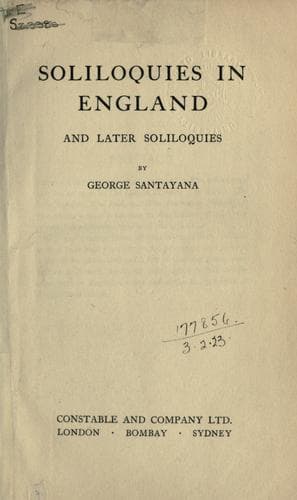
Soliloquies in England, and Later SoliloquiesSantayana, George
Philosophy
Soliloquies in England, and Later Soliloquies
Santayana, George
American essays -- 20th century
What sort of a world this is--I will not say in itself, but in respect
to us--can be perceived almost at once by any candid spirit, and the
Indians readily perceived it. They saw that substance is infinite, out
of _scale_ with our sensuous images and (except in the little vortex
that makes us up) out of sympathy with our endeavours; and that spirit
in us nevertheless can hold its own, because salvation lies in finding
joy in the truth, not in rendering fortune propitious, by some miracle,
to our animal interests. The spirit is at home in the infinite, and
morally independent of all the accidents of existence: nothing that
nature can produce outruns its potential scope, its desire to know the
truth; and its disinterestedness renders it free, free especially from
any concern about its own existence. It does not deem it the part of
piety to deny the fugitive, impotent, and fantastic nature of human
life. It knows that the thoughts of man and his works, however great
or delightful when measured by the human scale, are but the faintest
shimmer on the surface of being. On the ruin of humanistic illusions
(such as make up the religious philosophy of the West) it knows how to
establish a tender morality and a sublime religion.
Indian wisdom, intent on the infinity and unity of substance and on the
vanity of human life, neglected two inquiries which are nevertheless of
the greatest interest to the spirit, so long as this vain life endures.
The Indians did not study the movement and mechanism of nature: they
had no science. Their poets, in a sort of spectacular physics, were
content to paint vividly the images of sense, conscious of their
fugitive charm, and of their monstrous and delirious diversity.
They also neglected the art of rational conduct in this world; the
refinements of their moral discipline were all mystical; they were
determined by watching the movement of inner experience, and allowing
the fancy to distinguish its objects and its stages. They thought the
spirit could liberate itself by thinking, as by thinking it seemed
to have entangled itself in this mesh of dreams. But how could the
spirit, if it had been free originally, ever have attached its fortunes
to any lump of clay? Why should it be the sport of time and change
and the vicissitudes of affairs? From the point of view of the spirit
(which is that of the Indians) this question is absolutely insoluble;
a fact which drives them to say that this entanglement is not "real,"
but only an illusion of being entangled. Certainly substance is not
entangled, but persists and moves according to its nature; and if what
exists besides substance--its aspects and the spirit in us that notes
them--is not "real" because not substantial, then the unreal has the
privilege, as Democritus pointed out, of existing as well as the real,
and more obviously. But this subterfuge, of denying that appearance
exists, because its existence is only the seeming of its objects, was
Public-domain text, read in full here on John Shaqi.
Reviews
Reviews
No reviews yet
Be the first to share your thoughts on this work.
Elsewhere in the archive
Join the Discussion
Join the discussion
Sign in to leave a comment or review.
Sign InorCreate an account