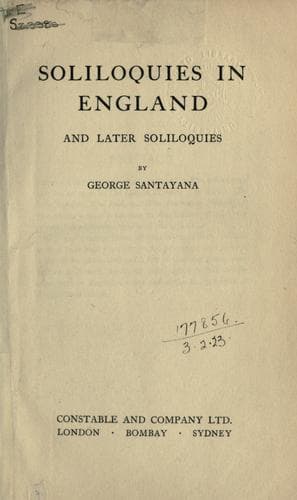
Soliloquies in England, and Later SoliloquiesSantayana, George
Philosophy
Soliloquies in England, and Later Soliloquies
Santayana, George
American essays -- 20th century
which to her is a mystery, because although she has always acted as if,
in some measure, she felt things at a distance, she has never seen and
never can see anything. Nor are his senses, for all their vivacity,
of any use to her. For what do they reveal to him? Always something
irrelevant: a shaft of dusty light across the rafters, a blue flame
dancing on the coals, a hum, a babbling of waters, a breath of heat or
of coolness, a mortal weariness or a groundless joy--all dream-images,
visions of a play world, essences painted on air, such as any poet
might invent in idleness. Yet the child cares about them immensely: he
is full of sudden tears and of jealous little loves. "Hush, my child,"
says good mother Psyche, "it's all nonsense." It is not for those
fantastic visions that she watches: she knits with her eyes shut, and
mutters her same old prayers. She has always groped amidst obstacles
like a mole pressing on where the earth is softest. She can tell
friends from enemies (not always correctly) by a mysterious instinct
within her, and the rhythm, as it were, of their approaching step. She
is long-suffering and faithful, like Penelope; but when hard-pressed
and at bay she becomes fierce. She is terribly absolute then, blindly
bent on vengeance and wild destruction. At other times she can melt
and be generous; in her beehive she is not only the congregation of
workers, but also the queen. Her stubborn old-womanish temper makes her
ordinarily unjust to her best impulses and hypocritical about her worst
ones. She is artful but not intelligent, least of all about herself.
For this reason she can never understand how she gave birth to such a
thankless child. She hardly remembers the warm ray from the sun or from
some other celestial source which one day pierced to her heart, and
begat there this strange uneasiness, this truant joy, which we call
thought. Seeing how quick and observant the brat is, she sometimes
sends him on errands; but he loiters terribly on the way, or loses
it altogether, forgets what he was sent for, and brings home nothing
but strange tales about Long-noses and Helmets-of-gold, whom he says
he has encountered. He prefers the poppies to the com, and half the
mushrooms he picks are of the poisonous variety; he sometimes insists
on setting apart his food for imaginary beings called the dead or the
gods; and worst of all, he once ravished and married a fairy, whom he
called Truth; and he wished to bring her to live with him at home. At
that, good mother Psyche naturally put her foot down. No hussies here!
Yet there are moments when she relents, when her worn old hands rest
in her lap, when she remembers and wonders, and two cold tears trickle
down from her blind eyes. What is the good of all her labour? Has it
all been, perhaps, for his sake, that he might live and sing and be
happy? Even in her green days, in her cool vegetable economy, there
had been waste; she had unwittingly put forth flowers she could not
Public-domain text, read in full here on John Shaqi.
Reviews
Reviews
No reviews yet
Be the first to share your thoughts on this work.
Elsewhere in the archive
Join the Discussion
Join the discussion
Sign in to leave a comment or review.
Sign InorCreate an account