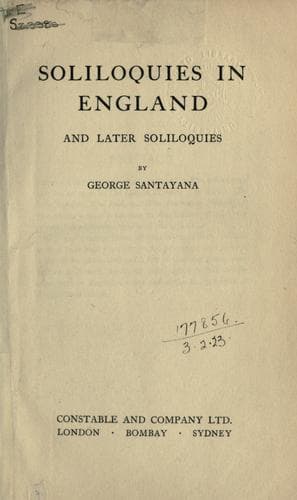
Soliloquies in England, and Later SoliloquiesSantayana, George
Philosophy
Soliloquies in England, and Later Soliloquies
Santayana, George
American essays -- 20th century
reported of her she is only walking in her sleep. The approach of
Hermes awakes her and lends her life--the only life she has. Her
true name is Illusion; and it is very characteristic of him, so rich
in pity, merriment, and shrewdness, to have chosen this poor child,
Illusion, for his love.
Hermes is the great interpreter, the master of riddles. I should not
honour him for his skill in riddles if I thought he invented them
wantonly, because he liked to puzzle himself with them, or to reduce
other people to a foolish perplexity without cause. I hate enigmas;
and if I believed that Hermes was the inspirer of those odious persons
who are always asking conundrums and making puns I should renounce him
altogether, break his statue, turn his picture to the wall, and devote
myself exclusively to the cult of some sylvan deity, all silence and
simple light. But I am sure Hermes loves riddles only because they are
no riddles to him; he is never caught in the tangle, and he laughs
to see how unnecessarily poor opinionated mortals befool themselves,
wilfully following any devious scent once they are on it by chance,
and missing the obvious for ever. He gives them what sly hints he can
to break the spell of their blindness; but they are so wedded to their
false preconceptions that they do not understand him, and are only the
more perplexed. Sometimes, however, they take the hint, their wit grows
nimble, their thoughts catch fire, and insight, solving every idle
riddle, harmonizes the jarring cords of the mind.
Public-domain text, read in full here on John Shaqi.
Reviews
Reviews
No reviews yet
Be the first to share your thoughts on this work.
Elsewhere in the archive
Join the Discussion
Join the discussion
Sign in to leave a comment or review.
Sign InorCreate an account