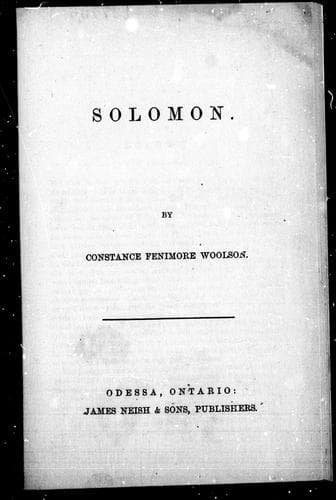
American fiction -- 19th century; Short stories, American
I ran forward and took her from the young men; she lay in my arms as if
dead. The poor child was sadly changed; always slender and swaying, she
now looked thin and shrunken, her skin had a strange, dark pallor, and
her lips were drawn in as if from pain. I could see her eyes through the
large-orbed thin lids, and the brown shadows beneath extended down into
the cheeks.
'Was ist's?' said Gustav, looking bewildered. 'Is she sick?'
I answered 'Yes,' but nothing more. I could see that he had no suspicion
of the truth, believing as he did that the 'good fellow' of a baker
would do very well for this 'good little thing' who was 'too quiet' for
him. The memory of Miss Martin sealed my lips. But if it had not been
for that pretty, flashy picture, would I not have spoken!
'You must go; you will miss the train,' I said after a few minutes. 'I
will see to Mina.'
But Gustav lingered. Perhaps he was really troubled to see the little
sweetheart of his boyhood in such desolate plight; perhaps a touch of
the old feeling came back; and perhaps also it was nothing of the kind,
and, as usual, my romantic thoughts were carrying me away. At any rate,
whatever it was, he stooped over the fainting girl.
'She looks bad,' he said, 'very bad. I wish-- But she'll get well and
marry the baker. Good bye, Mina.' And bending his tall form, he kissed
her colorless cheek, and then hastened away to join the impatient Karl;
a curve in the road soon hid them from view.
Wilhelmina had stirred at his touch; after a moment her large eyes
opened slowly; she looked around as if dazed, but all at once memory
came back and she started up with the same cry, 'Gustav, mein Gustav!' I
drew her head down on my shoulder to stifle the sound; it was better the
soldier should not hear it, and its anguish thrilled my own heart also.
She had not the strength to resist me, and in a few minutes I knew that
the young men were out of hearing as they strode on towards the station
and out into the wide world.
The forest was solitary, we were beyond the village; all the afternoon I
sat under the trees with the stricken girl. Again, as in her joy her
words were few; again as in her joy her whole being was involved. Her
little rough hands were cold, a film had gathered over her eyes; she did
not weep, but moaned to herself, and all her senses seemed blunted. At
nightfall I took her home, and the leathery mother received her with a
frown; but the child was beyond caring, and crept away, dumbly, to her
room.
Public-domain text, read in full here on John Shaqi.
Reviews
Reviews
No reviews yet
Be the first to share your thoughts on this work.
Join the Discussion
Join the discussion
Sign in to leave a comment or review.
Sign InorCreate an account