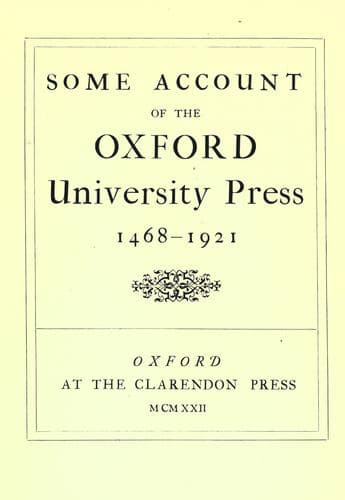
Some Account of the Oxford University Press, 1468-1921Oxford University Press
History
Some Account of the Oxford University Press, 1468-1921
Oxford University Press
Oxford University Press; Printing -- England -- Oxford -- History
Not the least of the services rendered by the Press was the printing
done for the Naval Intelligence Department of the Admiralty directed by
Admiral Sir Reginald Hall. Both secrecy and speed were essential to the
usefulness of this work, and to secure them the Printer to the University
made special arrangements involving a severe strain upon himself and
those to whom the work was entrusted. Admiral Hall, when unveiling the
Press War Memorial in October 1920, declared that the work done was
unique in kind, and that without the help of the Press the operations of
his Department could not have been carried out with success.
[Illustration: WOLVERCOTE PAPER MILL]
[Illustration: Rag Sorting]
[Illustration: Rag Cutting]
[Illustration: Rag Boiling]
[Illustration: Rag Breaking]
As the War dragged on, the numbers employed at the Press steadily
declined; the demands of Government as steadily increased; the shortage
of materials of all kinds became more and more acute. None the less
the Bible Press met an unprecedented demand for the New Testament by
supplying within three years four and a half million of copies for use
in the field. The Learned Press, too, continued to produce, though
the volume of production became less and less. The machinery of the
Dictionary, though its movement was retarded, never came to a standstill.
The scientific journals continued to appear, and not a few learned books
were published. A greater number, however, were placed in the Delegates’
safes, in expectation of the increased facilities which the end of the
War has hardly brought. The manufacturing powers of the Press, indeed,
have virtually reached their pre-war level; but the ever-rising cost of
labour and materials has made it as yet impossible to restore to its old
volume the output of books which could at no time have been remunerative.
It may be added that the Delegates, like other publishers, have had to
consider that the purchasing power of the public on which they rely has
not kept pace with the rise in costs. The price of books has of course
risen very greatly; but the ratio of increase has been substantially
lower than that of commodities in general.
§ 3. _Wolvercote Paper Mill_
The first mention of paper-making in or near Oxford is a story of one
Edwards, who about 1670 planned to erect a mill at Wolvercote and was
encouraged by Fell. In 1718 Hearne the antiquary wrote that ‘some of the
best paper in England is made at Wolvercote Mill’. It was bought by the
Press in 1870.
The Mill stands on a branch of the Thames, on the edge of the quiet
village of Wolvercote, and near the ruins of Godstow Nunnery. The
water-wheel has long ceased to play more than a very minor part in the
driving of the mill, which now has two modern paper-making machines, 72
and 80 inches wide respectively. The power used is partly steam, but a
large part of the plant has quite recently been electrified.
[Illustration: Beater Room]
[Illustration: Machine Room]
Public-domain text, read in full here on John Shaqi.
Reviews
Reviews
No reviews yet
Be the first to share your thoughts on this work.
Join the Discussion
Join the discussion
Sign in to leave a comment or review.
Sign InorCreate an account