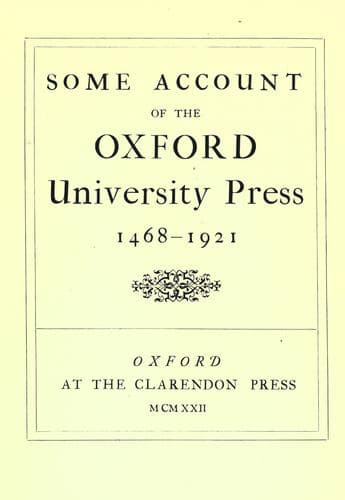
Some Account of the Oxford University Press, 1468-1921Oxford University Press
History
Some Account of the Oxford University Press, 1468-1921
Oxford University Press
Oxford University Press; Printing -- England -- Oxford -- History
[Illustration: Paper Sorting]
[Illustration: Paper Stock Warehouse]
Most varieties of high-class printing paper are made at Wolvercote,
which besides feeding the Press does a considerable trade with other
printers. The paper made for the Oxford Dictionary and some other books
is of the finest rag and is probably as durable as the best hand-made
paper of former times. But the Mill is best known for its ‘Bible’ papers,
exceptionally thin, tough, and opaque, with a fine printing surface.
Paper of this kind reaches its acme in the famous Oxford India Paper, the
invention of which made revolutionary changes in the printing of Bibles.
A great many Oxford books are now printed in two editions, an ordinary
and an India paper. If the saving of space is an important consideration,
the convenience of the thinner editions of such books as the _Concise
Oxford Dictionary_, the _Concise Dictionary of National Biography_, or
the _Oxford Survey of the British Empire_ is obvious; and many people
like to read the Poets and the Classics in thin and light volumes. The
_Oxford Homer_ will go into a pocket, though it has 1,374 pages; and
the India paper _Shakespeare_ and _Oxford Book of English Verse_ are
delightfully easy to carry and handle.
The Controller of the Mill is Mr. Douglas Clapperton (a name well known
in the paper trade), who succeeded Mr. Joseph Castle in 1916.
§ 4. _The Press in London_
The association of the Oxford Press with London booksellers—the
publishers of former days—goes back to early times. Apart from the
negative agreement with the Stationers’ Company, _not_ to print Bibles
and Almanacks, we find, at the end of the seventeenth century, Oxford
Bibles bearing the imprint of various London booksellers. In 1776 Dr.
Johnson wrote to the Master of University College a letter, printed
by Boswell, in which he sets forth with knowledge and perspicacity
the philosophy of bookselling; the moral of the discourse is that the
University must offer more attractive discounts to the book trade—a
doctrine which has been adopted in modern times, though in 1776 it
perhaps fell upon deaf ears.
Not later than 1770 a Bible Warehouse was established in Paternoster
Row. But it was not until a century later that the Press undertook
the distribution in London of its secular books. In 1884 these books,
formerly sold by Messrs. Macmillan, were taken over by the Manager of
the Bible Warehouse, Mr. Henry Frowde, who thus became sole publisher to
the University; an office which he continued to hold with great skill,
devotion, and success until on his retirement in 1913 he was succeeded by
Mr. Humphrey Milford.
[Illustration: AMEN CORNER LONDON]
Public-domain text, read in full here on John Shaqi.
Reviews
Reviews
No reviews yet
Be the first to share your thoughts on this work.
Join the Discussion
Join the discussion
Sign in to leave a comment or review.
Sign InorCreate an account