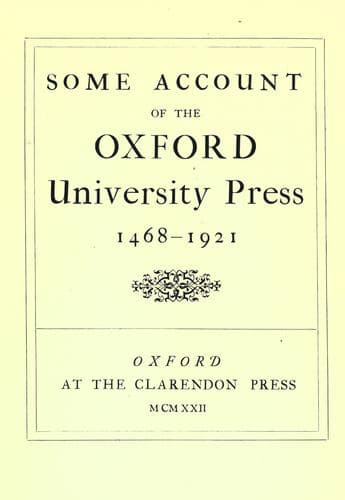
Some Account of the Oxford University Press, 1468-1921Oxford University Press
History
Some Account of the Oxford University Press, 1468-1921
Oxford University Press
Oxford University Press; Printing -- England -- Oxford -- History
The Press is so strong in books on _India_ that it has seemed well to
issue a special catalogue bringing together a mass of books which in the
General Catalogue are listed under a variety of subject-headings. These
include a large and important section published by the Press under the
patronage of the Secretary of State—notably the _Imperial Gazetteer of
India_ in twenty-six volumes, the noble series of documents on the early
history of ‘John Company’ compiled at the India Office, and the sumptuous
publication of Sir Aurel Stein’s discoveries in Turkestan; but they
include also a whole library of books produced by the Press at its sole
charges and dealing with the history of India from the Empire of Asoka to
the formulation of Dyarchy, with the geography, politics, and economics
of modern India, and with the religion and literature, the fine art, and
the music of Hindostan. The production by the Press in India itself of
vernacular and other educational books has recently made great progress.
(See also p. 65 for some notice of the series of _Classics of Indian
History_.)
§ 3. _The Oxford Standard_
The standard of scholarship, accuracy, and literary excellence which
the Delegates maintain in the books published under their authority
is believed to be as high as that attempted by any other publisher
in the world. Its maintenance imposes upon the Delegates much labour
and expense; but the effort is repaid in the reputation which Oxford
books enjoy in the public estimation. The supervision exercised by the
Delegates, both personally and through their advisers, is not limited to
the initial judgement passed upon a book offered to them for publication;
it extends through the whole process of revision in manuscript and
in proof. When a book is favourably considered, an expert’s detailed
report is very often laid before the author, who is asked to consider
the suggestions made and to confer with the Delegates’ advisers; and
this process of scrutiny is frequently far-reaching, the criticism being
invited at one stage or another of a number of specialists in various
fields. In this way many, perhaps most, of the books produced by the
Press have received substantial improvement; and not a few have undergone
something like transformation. To these benefits abundant testimony is
borne in the prefaces of authors; more, perhaps, reposes in the archives
in Walton Street.
Public-domain text, read in full here on John Shaqi.
Reviews
Reviews
No reviews yet
Be the first to share your thoughts on this work.
Join the Discussion
Join the discussion
Sign in to leave a comment or review.
Sign InorCreate an account