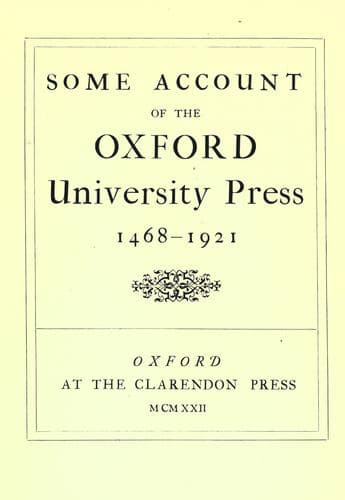
Some Account of the Oxford University Press, 1468-1921Oxford University Press
History
Some Account of the Oxford University Press, 1468-1921
Oxford University Press
Oxford University Press; Printing -- England -- Oxford -- History
The technical services rendered to scholarship by the Clarendon Press
proof-readers are likewise commemorated in many a preface. The late
Mr. J. C. Pembrey, who in 1847 read Wilson’s _Sanskrit Grammar_, and
in 1916 read Prof. Macdonell’s _Vedic Grammar_ for press, was well
known to three generations of Oriental scholars; the late Mr. W. F. R.
Shilleto did much to secure accuracy and uniformity in the series of
_Oxford Classical Texts_; and Mr. George Ostler has left the marks of
his vigilance upon many editions of the English classics. Long training
in a severe school develops unusual powers; and authors are sometimes
startled by instances of what seems beyond natural acumen. An author who
had misquoted _Tempora mutantur, nos et mutamur in illis_ in the usual
form, was naturally astonished when the reader inquired in the margin
‘Should it not be _et nos_?’, which is of course unmetrical. The reader
was right, nevertheless; but the source of his information remained
obscure. In fields less recondite than this the authority of the readers
is generally recognized; many editors have confessed that in the matter
of Greek accents they should not think of disputing it.
The attention thus paid to the claims of scholarship and accuracy brings
doubtless unmixed benefits to learning and education. To the Press as
a business concern the blessing is less unequivocal. The Delegates’
resources are not without limits; and they are sometimes embarrassed by
the ambitions of learned authors from all parts of the world, to whom
nothing but the imprint of the Clarendon Press seems an adequate reward.
They are obliged to pick and choose, and sometimes to decline a proposal
which would attract them if it had fewer rivals. Another imputation is
less deserved. A distinguished American who had been invited to dine in
an Oxford College confessed afterwards that as he entered the room his
knees knocked at the thought that ‘all these Fellows talked Latin’;
and the public is sometimes frightened away from an Oxford book by the
apprehension that it will be found full of Greek quotations. There is in
fact no necessary connexion between accuracy and pedantry; and even Dons
are often men of the world, well acquainted with the limitations of the
average intelligence. No one need be afraid that an Oxford book on any
ordinary subject will be any more abstruse than another book, though its
facts will perhaps be better authenticated and its arguments more closely
reasoned. The booksellers know this; and in reply to a customer’s inquiry
‘Is this a good book?’ have been heard to reply ‘Why it’s an Oxford book’.
Public-domain text, read in full here on John Shaqi.
Reviews
Reviews
No reviews yet
Be the first to share your thoughts on this work.
Join the Discussion
Join the discussion
Sign in to leave a comment or review.
Sign InorCreate an account