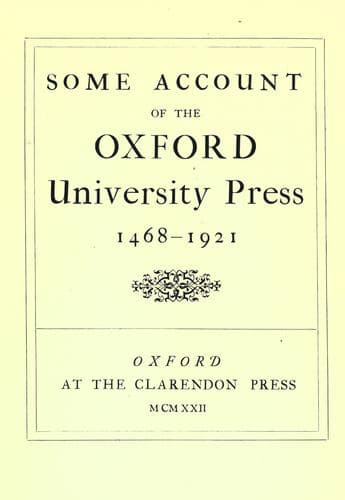
Some Account of the Oxford University Press, 1468-1921 — John Shaqi
Some Account of the Oxford University Press, 1468-1921Oxford University Press
History
Some Account of the Oxford University Press, 1468-1921
Oxford University Press
Oxford University Press; Printing -- England -- Oxford -- History
Another fallacy which dies hard is that Oxford books are dear. This
is perhaps no more than a hasty inference from the fact that Oxford
produces an exceptionally large proportion of books which from their
nature cannot be cheap. No one would expect to buy Liddell and Scott’s
Greek Lexicon, or the _Index Kewensis_, for a few shillings; but these
books and many like them are really inexpensive, if regard is paid to
the number of words they contain. The Oxford Dictionary itself is sold
at an almost nominal price. Many of the books, however, which appeal to
a narrow public are properly priced higher than if they could be sold in
large numbers; for the price of a book depends mainly upon two things—the
number of words it contains and the number of people who will buy it.
The art of publishing lies in nothing so much as in estimating whether a
book is more likely to sell say, 750 copies at 15_s._ or 5,000 at 5_s._
The policy of the Press has always been elastic in this respect; and very
many of its books are among the cheapest in their kind.
[Illustration: Specimen of work done by M. Burghers, Engraver to the
University about 1700]
[Illustration: Specimen of work done in the studio of the Clarendon Press
to-day]
[Illustration: From Lily’s Latin Grammar, Oxford 1692]
[Illustration: One of the drawings by Henry Ford from _A School History
of England_ by C. R. L. Fletcher and Rudyard Kipling, 1911]
§ 4. _Illustrated Books_
The publication by the Press of beautifully illustrated books is mainly
a development of comparatively recent years, and it has been furthered
by the progress of collotype printing at Oxford. The catalogue now
includes a large number of sumptuous monographs on artistic subjects.
In its facsimiles of manuscripts and rare printed books, published on
its own account or for the British Museum, the Press has done much to
make accessible to scholars the treasures of the great collections.
Well-known examples are the magnificent collotype reproduction of the
New Testament part of the _Codex Sinaiticus_ (from negatives made at St.
Petersburg under the old régime; negatives were fortunately made of the
Old Testament part as well, and the reproduction of the whole of this
most famous of all manuscripts will before long be completed); and the
complete collotype reproduction of the Shakespearian corpus, consisting
of the Folio of 1623, which went out of print on publication in 1912, and
the _Poems and Pericles_ from the first editions, still on sale.
Public-domain text, read in full here on John Shaqi.
Reviews
Reviews
No reviews yet
Be the first to share your thoughts on this work.
Join the Discussion
Join the discussion
Sign in to leave a comment or review.
Sign InorCreate an account