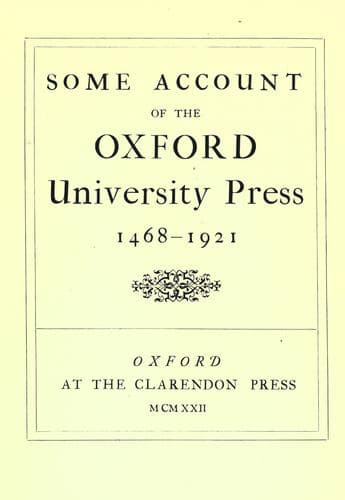
Some Account of the Oxford University Press, 1468-1921 — John Shaqi
Some Account of the Oxford University Press, 1468-1921Oxford University Press
History
Some Account of the Oxford University Press, 1468-1921
Oxford University Press
Oxford University Press; Printing -- England -- Oxford -- History
Of the _Bible Side_ the ground floor is now the press room or _Machine
Room_, which, with its more recent extensions, holds about fifty
machines, from the last survivor of the old flat-impression double
Platens to the most modern American double-cylinder ‘perfecting’ presses
with their automatic ‘feeders’. All kinds of printing are done here,
from the small numbers of an oriental book or a Prayer Book in black and
red to the largest impression of a Bible printed in sheets containing
320 pages each. The long experience of printing Bibles on thin paper and
especially on Oxford India paper has given the Oxford machine-minder an
unrivalled dexterity in the nice adjustment required to produce a fine
clean effect on paper which will not stand a heavy impression.
As the sheets come from machine they are sent to the _Bindery_. This
was until recently on the floor above the machine room, but has lately
been transferred to a larger and more convenient building erected in the
old garden behind the Press. The Oxford Bindery deals with most of the
Clarendon Press books in cloth bindings, and prides itself upon the fine
finish of the cases and gilding of such beautiful books as the _Oxford
Book of English Verse_, as well as on being able to turn out artistic and
attractive cloth and paper bindings for books sold at the lowest prices.
It still deals with a part only of the books printed under the same roof;
but a large expansion is looked for in the near future.
Between the two wings, and across the quadrangle, are two houses once
occupied by the late Horace Hart and by Dr. Henry Bradley, now the senior
of the three editors of the Oxford Dictionary. The houses became some
years ago unfit for habitation from the encroachment of machinery; but
one of them was a welcome refuge during the years of war to the staff of
the Oxford Local Examinations, who on the 5th of August 1914 were turned
out of their office at an hour’s notice to make room for a Base Hospital.
Adjacent to the houses are the fire-proof _Plate Room_, where some 750
tons of metal are stored, the _Stereotype and Electrotype Foundry_,
and the _Monotype Rooms_, a department which has lately added to its
equipment and bids fair to pass the ancient composing rooms in output.
Other departments in and about the old building are the _Photographic
Room_, famous for its collotype printing, the _Type Foundry_, where Fell
type is still cast from the old matrices, and the _Ink Factory_.
The front of the building on Walton Street consists chiefly of packing
rooms, where books are dispatched by rail or road to the City of London
and elsewhere, and of offices—those of the Printer to the University on
the ground floor and those of the Secretary to the Delegates above. Here
are reference libraries of books printed or published by the Press, and
records ranging from the oldest Delegates’ minute-book of the seventeenth
century to modern type-written correspondence arranged on the ‘vertical’
system of filing.
Public-domain text, read in full here on John Shaqi.
Reviews
Reviews
No reviews yet
Be the first to share your thoughts on this work.
Join the Discussion
Join the discussion
Sign in to leave a comment or review.
Sign InorCreate an account