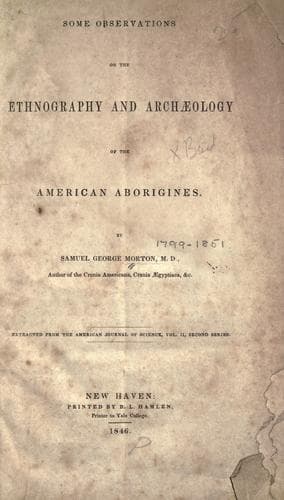
Some Observations on the Ethnography and Archaeology of the American AboriginesMorton, Samuel George
History
Some Observations on the Ethnography and Archaeology of the American Aborigines
Morton, Samuel George
Indians
Who does not see in the builders of these humbler dwellings, the
descendants of the architects of Palenque, and Yucatan? The style is the
same in both. The same objects have been arrived at by similar modes of
construction. The older structures are formed of a better material,
generally of hewn stone, and often elaborately ornamented with
sculpture. But the absence of all decoration in the modern buildings, is
no proof that they have not been erected by people of the same race with
those who have left such profusely ornamented monuments in other parts
of Mexico; for the ruins of Pueblo Bonito, in the direction of Navajo,
and those of the celebrated Casas Grandes on the western Colorado, which
were regarded by Clavigero as among the oldest Toltecan remains in
Mexico, are destitute of sculpture or other decoration. In fact, these
last named ruins appear to date with the primitive wanderings of the
cultivated tribes, before they established their seats in Yucatan and
Guatimala, and erected those more finished monuments which could only
result from the combined efforts of populous communities, acting under
the favorable influence of peace and prosperity. Every race has had its
center or centers of comparative civilization. The American aborigines
had theirs in Peru, Bogota and Mexico. The people, the institutions and
the architecture were essentially the same in each, though modified by
local wants and conventional usages. Humboldt was forcibly impressed by
this archæological identity, for he himself had traced it, with
occasional interruptions, over an extent of a thousand leagues; and we
now find that it gradually merges itself into the ruder dwellings of the
more barbarous tribes; showing, as I have often remarked, that there is,
in every respect, a gradual ethnographic transition from these into the
temple-builders of every American epoch.[14-*]
I shall close this communication by a notice of certain _discoidal
stones_ occasionally found in the mounds of the United States. Of these
relics I possess sixteen, of which all but two were found by my friend
Dr. Wm. Blanding, during his long residence in Camden, South Carolina.
These disks were accompanied, as usual, by earthern[TN-3] vessels, pipes
of baked clay, arrow-heads and other articles, respecting which Dr.
Blanding has given me the following locality:--"All the Indian relics,
save three or four, which I have sent you, were collected on or near the
banks of the Wateree river, Kershaw district, South Carolina; the
greater part from the mounds or near the foot of them. All the mounds
that I have observed in this state, excepting these, do not amount to as
many as are found on the Wateree within the distance of twenty four
miles up and down the river, between Lancaster and Sumpter districts.
The lowest down is called Nixon's mound, the highest up, Harrison's."
Public-domain text, read in full here on John Shaqi.
Reviews
Reviews
No reviews yet
Be the first to share your thoughts on this work.
Join the Discussion
Join the discussion
Sign in to leave a comment or review.
Sign InorCreate an account