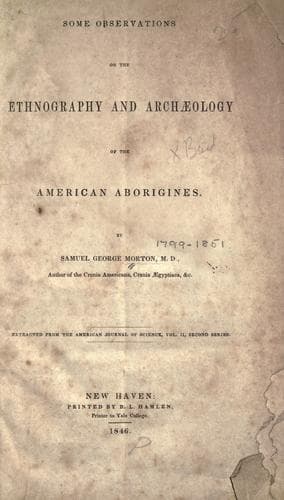
Some Observations on the Ethnography and Archaeology of the American Aborigines — John Shaqi
Some Observations on the Ethnography and Archaeology of the American AboriginesMorton, Samuel George
History
Some Observations on the Ethnography and Archaeology of the American Aborigines
Morton, Samuel George
Indians
"The discoidal stones," adds Dr. Blanding, "were found at the foot of
the different mounds, not in them. They seemed to be left, where they
were no doubt used, on the play grounds."
The disks are from an inch and a half to six inches in diameter, and
present some varieties in other respects.
[Illustration]
Fig. 1 represents a profile of the simplest form and at the same time
the smallest size of these stones, being in diameter about an inch and
three quarters. The upper and under surfaces are nearly plane, with
angular edges and oblique margin, but without concavity or perforation.
Fig. 2. A similar form, slightly concave on each surface.
Fig. 3. A large disk of white quartz, measuring five inches in diameter
and an inch and three fourths in thickness. The margin is rounded, and
both surfaces are deeply concave though imperforate.
Fig. 4 is another specimen four inches in diameter, deeply concave from
the margin to the center, with a central perforation. The margin itself
is slightly convex. The concave surface is marked by two sets of
superficial grooved lines, which meet something in the form of a
bird-track. This disk is made of a light-brown ferruginous quartz.
Fig. 5 is a profile view of a solid lenticular stone, much more convex
on the one side than the other, formed of hard syenitic rock.
Besides these there are other slight modifications of form which it is
unnecessary to particularize.
These disks are made of the hardest stones, and wrought with admirable
symmetry and polish, surpassing any thing we could readily conceive of
in the humbler arts of the present Indian tribes; and the question
arises, whether they are not the works of their seemingly extinct
progenitors?--of that people of the same race, (but more directly allied
to the Toltecans of Mexico,) who appear in former times to have
constituted populous and cultivated communities throughout the valley of
the Mississippi, and in the southern and western regions towards the
gulf of Mexico, and whose last direct and lineal representatives were
the ill-fated Natchez?
Public-domain text, read in full here on John Shaqi.
Reviews
Reviews
No reviews yet
Be the first to share your thoughts on this work.
Join the Discussion
Join the discussion
Sign in to leave a comment or review.
Sign InorCreate an account