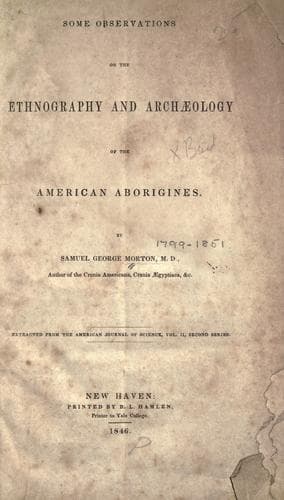
Some Observations on the Ethnography and Archaeology of the American AboriginesMorton, Samuel George
History
Some Observations on the Ethnography and Archaeology of the American Aborigines
Morton, Samuel George
Indians
It has been objected to a common origin for all the American nations,
and even for those of Mexico, that their _monuments_ should present so
great a variety in the configuration of the head and face; a fact which
forcibly impresses every one who examines the numerous effigies in baked
clay in the collection of the American Philosophical Society; yet they
are all made of the same material and by the same national artists. The
varieties are indeed endless; and Mr. Norman in his first work, has
arrived at a reasonable conclusion, in which we entirely agree with him,
"that the people prepared these _penates_ according to their respective
tastes, and with little reference to any standard or canon."[10-*]
They appear to have exercised much ingenuity in this way, blending
almost every conceivable type of the human countenance, and associating
this again with those of beasts, birds, and various fanciful animals,
which last are equal in uncouthness to any productions of the Gothic
artists of the middle ages.
Mr. Norman in his late and interesting volume of travels in Cuba and
Mexico, discovered in the latter country some remarkable ruins near the
town of Panuco, and among them a curious sepulchral effigy. "It was a
handsome block or slab of stone, (wider at one end than the other,)
measuring seven feet in length, with an average of nearly two and a half
feet in width and one foot in thickness. Upon its face was beautifully
wrought, in bold relief, the full length figure of a man, in a loose
robe with a girdle about his loins, his arms crossed on his breast, his
head encased in a close cap or casque, resembling the Roman helmet (as
represented in the etchings of Pinelli) without the crest, and his feet
and ankles bound with the ties of sandals. The figure is that of a tall
muscular man of the finest proportions. The face, in all its features,
is of the noblest class of the European or Caucasian race."[10-+]
Mr. Norman was himself struck "with the resemblance between this, and
the stones that cover the tombs of the Knights Templar in some of the
ancient churches of the old world," but he thinks that neither this nor
any other circumstance proves this effigy to have been of European
origin or of modern date. "The material," he adds, "is the same as that
of all the buildings and works of art in this vicinity, and the style
and workmanship are those of the great unknown artists of the western
hemisphere;" and he arrives at the conclusion, as many ingenuous minds
have done before him, that these and the other archæological remains of
Mexico and Yucatan, "are the works of a people who have long since
passed away; and not of the races, _or the progenitors of the races_,
who inhabited the country at the epoch of the discovery."[11-*]
Public-domain text, read in full here on John Shaqi.
Reviews
Reviews
No reviews yet
Be the first to share your thoughts on this work.
Join the Discussion
Join the discussion
Sign in to leave a comment or review.
Sign InorCreate an account