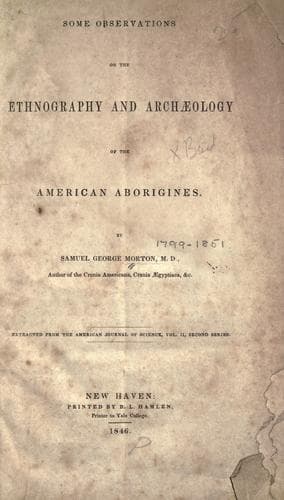
Some Observations on the Ethnography and Archaeology of the American Aborigines — John Shaqi
Some Observations on the Ethnography and Archaeology of the American AboriginesMorton, Samuel George
History
Some Observations on the Ethnography and Archaeology of the American Aborigines
Morton, Samuel George
Indians
With the highest respect for this intelligent traveller, I am not able
to agree with him in his conclusion; but I should not now revive my
published opinions or contest his, were it not that some new light
appears to me to have dawned on this very question.
In the first place, then, we regard the effigy found near Panuco as
probably Caucasian; so does Mr. Norman; but instead of referring it to a
very remote antiquity, or to some European occupancy of Mexico long
before the Spanish conquest, we will venture to suggest, that even if
the town of Panuco was itself older than that event, (of which indeed we
have no doubt,) it is consistent with collateral facts to infer, that
the Spaniards may have occupied this very town, in common with, or
subsequent to, the native inhabitants, and have left this sepulchral
monument. That the Spaniards did sometimes practice this joint
occupancy, is well known; and that they have, in some instances, left
their monuments in places wherein even tradition had almost lost sight
of their former sojourn, is susceptible of proof.
Mr. Gregg, in a recent and instructive work on the "Commerce of the
Prairies," states the following particulars, which are the more valuable
since he had no opinions of his own in reference to the American
aborigines, and merely gives the facts as he found them.
Mr. Gregg describes the ruins called _La Gran Quivira_, about 100 miles
south of Santa Fé, as larger than the present capital of New Mexico. The
architecture of this deserted city is of hewn stone, and there are the
remains of aqueducts eight or ten miles in length leading from the
neighboring mountains. These ruins "have been supposed to be the remains
of a _pueblo_ or aboriginal city;" but he adds that the occurrence of
the Spanish coat of arms in more than one instance sculptured and
painted upon the houses, prevents the adoption of such an opinion; and
that traditional report (and tradition only) mentions this as a city
that was sacked and desolated in the Indian insurrection of 1680.[12-*]
Now had it not been for the occurrence of the heraldic paintings, this
city might have been still regarded as of purely Indian origin and
occupancy; as might also the analogous ruins of Abo, Tagique and Chilili
in the same vicinity; for although these may have been originally
constructed by the natives, yet as they are supposed to be near the
ancient mines, it is not improbable that the conquerors in these, as in
many other instances, drove out the rightful owners, and took possession
for themselves;[12-+] for that they did possess and inhabit the towns
above enumerated is a fact beyond question.
Public-domain text, read in full here on John Shaqi.
Reviews
Reviews
No reviews yet
Be the first to share your thoughts on this work.
Join the Discussion
Join the discussion
Sign in to leave a comment or review.
Sign InorCreate an account