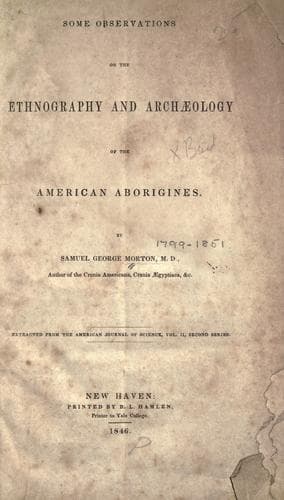
Some Observations on the Ethnography and Archaeology of the American AboriginesMorton, Samuel George
History
Some Observations on the Ethnography and Archaeology of the American Aborigines
Morton, Samuel George
Indians
Why may not events of an analogous character have taken place at Panuco?
Was it not probably an Indian city into which the Spaniards had intruded
themselves, and having left traces of their sojourn, as at _La Gran
Quivira_, subsequently, owing to some dire catastrophe, or some new
impulse, abandonded[TN-2] it for another and preferable location? This,
we suggest, is a reasonable explanation of the presence of the Caucasian
effigy found by Mr. Norman among the deserted ruins of Panuco.
Mr. Stephens has, I think, conclusively proved that the past and present
Indian races of Mexico were cognate tribes. I had previously arrived at
the same conclusion from a different kind of evidence. What was manifest
in the physical man is corroborated by his archæological remains. The
reiterated testimony of some of the early Spanish travellers, and
especially of Bernal Diaz and Herrera, is of the utmost importance to
this question; and all that is necessary in the chain of evidence, is
some link to connect the demi-civilized nations with the present
uncultivated and barbarous tribes. These links have been supplied by Mr.
Gregg. Those peculiar dwellings and other structures, with inclined or
parapet walls,[12-++] and with or without windows, which are common to
all epochs of Peruvian and Mexican architecture, are constructed and
occupied by the Indians of Mexico even at the present day. After
describing the general character of these modern domicils, Mr. Gregg
goes on to observe, that "a very curious feature in these buildings, is
that there is most generally no direct communication between the street
and the lower rooms, into which they descended from a trap-door from the
upper story, the latter being accessible by means of a ladder. Even the
entrance at the upper stories is frequently at the roof. This style of
building appears to have been adopted for security against their
marauding neighbors of the wilder tribes, with whom they were often at
war.
Public-domain text, read in full here on John Shaqi.
Reviews
Reviews
No reviews yet
Be the first to share your thoughts on this work.
Join the Discussion
Join the discussion
Sign in to leave a comment or review.
Sign InorCreate an account