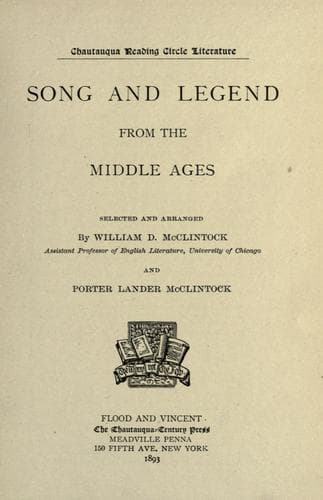
Literature, Medieval -- History and criticism; Literature, Medieval -- Translations into English
came to Galahad, and he kneeled down and there he received his
Saviour, and after him so received all his fellows; and they
thought it so sweet that it was marvellous to tell. Then said he
to Galahad, Son, wotest thou what I hold betwixt my hands? Nay,
said he, but if ye will tell me. This is, said he, the holy dish
wherein I ate the lamb on Sher-thursday. And now hast thou seen
that thou most desiredst to see, but yet hast thou not seen it so
openly as thou shalt see it in the city of Sarras, in the
spiritual place.
LYRIC POETRY--FRENCH.
Lyric poetry sprang up very early in Northern France, having a
spontaneous and abundant growth in the twelfth and thirteenth
centuries. Of the earliest lyrics, the critics distinguish two
varieties (l) the Romance, and (2) the Pastourelle. These are
generally dramatic love stories, full of gay and simple life and
extremely artistic and musical in form. Along with these was
produced a vast amount of simple lyric poetry on love and other
personal emotions. The number of poems written was immense. About
two hundred names of poets have come down to us, besides hundreds
of anonymous pieces.
The Romances and Pastourelles of the northern trouveres were soon
greatly influenced by the more artful poetry of the Provencal
troubadours, producing the highly artificial but charming
rondeaus and ballades of the fourteenth and fifteenth centuries.
But the freshest, most individual work is that of the earlier
time.
CHATELAIN DE COUCY. Thirteenth Century.
The first approach of the sweet spring
Returning here once more,--
The memory of the love that holds
In my fond heart such power,--
The thrush again his song assaying,--
The little rills o'er pebbles playing,
And sparkling as they fall,--
The memory recall
Of her on whom my heart's desire
Is, shall be, fixed till I expire.
With every season fresh and new
That love is more inspiring:
Her eyes, her face, all bright with joy,--
Her coming, her retiring,
Her faithful words, her winning ways,--
That sweet look, kindling up the blaze,
Of love, so gently still,
To wound, but not to kill,--
So that when most I weep and sigh,
So much the higher springs my joy.
--Tr. by Taylor.
THIBAUT OF CHAMPAGNE, KING OF NAVARRE. Early Thirteenth Century.
Lady, the fates command, and I must go,--
Leaving the pleasant land so dear to me:
Here my heart suffered many a heavy woe;
But what is left to love, thus leaving thee?
Alas! that cruel land beyond the sea!
Why thus dividing many a faithful heart,
Never again from pain and sorrow free,
Never again to meet, when thus they part?
I see not, when thy presence bright I leave,
How wealth, or joy, or peace can be my lot;
Ne'er yet my spirit found such cause to grieve
As now in leaving thee; and if thy thought
Of me in absence should be sorrow-fraught,
Oft will my heart repentant turn to thee,
Dwelling in fruitless wishes, on this spot,
And all the gracious words here said to me.
Public-domain text, read in full here on John Shaqi.
Reviews
Reviews
No reviews yet
Be the first to share your thoughts on this work.
Join the Discussion
Join the discussion
Sign in to leave a comment or review.
Sign InorCreate an account