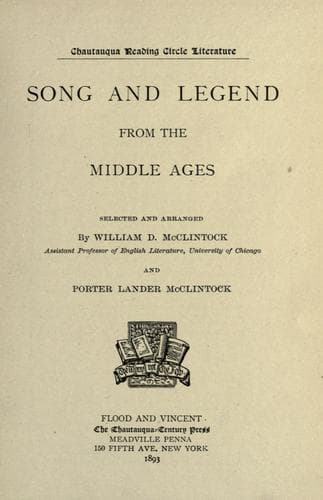
Literature, Medieval -- History and criticism; Literature, Medieval -- Translations into English
O gracious God! to thee I bend my knee,
For thy sake yielding all I love and prize;
And O, how mighty must that influence be,
That steals me thus from all my cherished joys!
Here, ready, then, myself surrendering,
Prepared to serve thee, I submit; and ne'er
To one so faithful could I service bring,
So kind a master, so beloved and dear.
And strong my ties,--my grief unspeakable!
Grief, all my choicest treasures to resign;
Yet stronger still the affections that impel
My heart toward Him, the God whose love is mine.
That holy love, how beautiful! how strong!
Even wisdom's favorite sons take refuge there;
'T is the redeeming gem that shines among
Men's darkest thoughts,--for ever bright and fair.
--Tr. by Taylor.
GACE BRULE. Thirteenth Century.
The birds, the birds of mine own land
I heard in Brittany;
And as they sung, they seemed to me
The very same I heard with thee.
And if it were indeed a dream,
Such thoughts they taught my soul to frame
That straight a plaintive number came,
Which still shall be my song,
Till that reward is mine which love hath promised long.
--Tr. by Taylor.
RAOUL DE SOISSONS. Thirteenth Century.
Ah! beauteous maid,
Of form so fair!
Pearl of the world,
Beloved and dear!
How does my spirit eager pine
But once to press those lips of thine!--
Yes, beauteous maid,
Of form so fair!
Pearl of the world,
Beloved and dear!
And if the theft
Thine ire awake,
A hundred fold
I'd give it back,--
Thou beauteous maid,
Of form so fair!
Pearl of the world,
Beloved and dear!
--Tr. by Taylor.
LATER FRENCH LYRICS.
During the latter half of the thirteenth century several new and
highly artificial forms of verse were developed. The chief of
these were the Ballade and Chant Royal, the Rondel, Roudeau,
Triolet, Virelay. These are all alike in being short poems,
generally treating of love, and making special use of a refrain
and the repetition of words and lines. They differ in the number
of verses in a stanza, of stanzas In the poem, and the order and
number of rhymes. Their poetic value is not great because the
poet so easily lost sight of his subject in perfecting his verse
form.
A TRIOLET.
Take time while yet it is in view,
For fortune is a fickle fair:
Days fade, and others spring anew;
Then take the moment still in view.
What boots to toil and cares pursue?
Each month a new moon hangs in air.
Take, then, the moment still in view,
For fortune is a fickle fair.
--Froissart. Tr. Anonymous.
RONDEL.
Now Time throws off his cloak again
Of ermined frost, and cold and rain,
And clothes him in the embroidery
Of glittering sun and clear blue sky.
With beast and bird the forest rings,
Each in his jargon cries or sings;
And Time throws off his cloak again
Of ermined frost, and cold and rain.
River, and fount, and tinkling brook
Wear in their dainty livery
Drops of silver jewelry;
In new-made suit they merry look;
And Time throws off his cloak again
Of ermined frost, and cold and rain.
Public-domain text, read in full here on John Shaqi.
Reviews
Reviews
No reviews yet
Be the first to share your thoughts on this work.
Join the Discussion
Join the discussion
Sign in to leave a comment or review.
Sign InorCreate an account