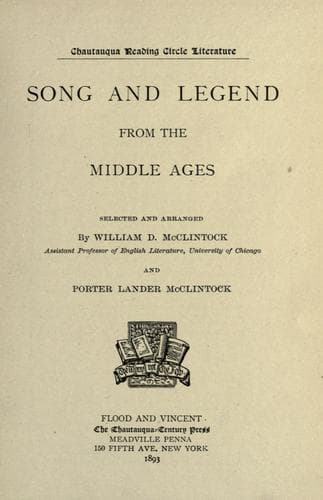
Literature, Medieval -- History and criticism; Literature, Medieval -- Translations into English
Companion dear! forth from the window looking,
Attentive mark the signs of yonder heaven;
Judge if aright I read what they betoken:
Thine all the loss, if vain the warning given.
The morn, the morn is near.
Companion dear! since thou from hence wert straying,
Nor sleep nor rest these eyes have visited;
My prayers unceasing to the Virgin paying,
That thou in peace thy backward way might tread.
The morn, the morn, is near.
Companion dear! hence to the fields with me!
Me thou forbad'st to slumber through the night,
And I have watched that livelong night for thee;
But thou in song or me hast no delight,
And now the morn is near.
ANSWER.
Companion dear! so happily sojourning,
So blest am I, I care not forth to speed:
Here brightest beauty reigns, her smiles adorning
Her dwelling-place,--then wherefore should I heed
The morn or jealous eyes?
--Tr. by Taylor.
FABLES AND TALES.
FABLES.
A large and popular class of writing of the French Middle Ages
was that of FABLIAUX or Fables. A Fable is "a recital, for the
most part comic, of a real or possible event occurring in the
ordinary affairs of human life."[1] We possess some two hundred
of these fables, varying in length from twenty to five hundred
lines. They are generally mocking, jocular, freespoken, half
satirical stories of familiar people, and incidents in ordinary
life. The follies of the clergy are especially exposed, though
the peasants, knights, and even kings furnish frequent subjects.
They are commonly very free and often licentious in language. The
following is an example of the simpler kind of Fables.
[1] Quoted by Saintsbury from M. de Montaiglon, editor of the
latest collection of Fabliaux (Parts 1872-'88).
THE PRIEST WHO ATE MULBERRIES.
Ye lordlings all, come lend an ear;
It boots ye naught to chafe or fleer,
As overgrown with pride:
Ye needs must hear Dan Guerin tell
What once a certain priest befell,
To market bent to ride.
The morn began to shine so bright,
When up this priest did leap full light
And called his folk around:
He bade them straight bring out his mare,
For he would presently repair
Unto the market-ground.
So bent he was on timely speed,
So pressing seemed his worldly need,
He weened 't were little wrong
If pater-nosters he delayed,
And cast for once they should be said
E'en as he rode along.
And now with tower and turret near
Behold the city's walls appear,
When, as he turned aside,
He chanced in evil hour to see
All hard at hand a mulberry-tree
That spread both far and wide.
Its berries shone so glossy black,
The priest his lips began to smack,
Full fain to pluck the fruit;
But, woe the while! the trunk was tall,
And many a brier and thorn did crawl
Around that mulberry's root.
Public-domain text, read in full here on John Shaqi.
Reviews
Reviews
No reviews yet
Be the first to share your thoughts on this work.
Join the Discussion
Join the discussion
Sign in to leave a comment or review.
Sign InorCreate an account