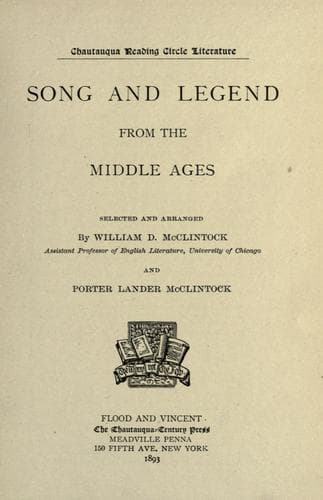
Literature, Medieval -- History and criticism; Literature, Medieval -- Translations into English
No, never since the fatal time
When the world fell for woman's crime,
Has Heaven in tender mercy sent--
All preordaining, all foreseeing--
A breath of purity that lent
Existence to so fair a being!
Whatever earth can boast of rare,
Of precious, and of good,--
Gaze on her form, 't is mingled there,
With added grace endued.
Why, why is she so much above
All others whom I might behold,
Whom I, unblamed, might dare to love,
To whom my sorrows might be told?
O, when I see her, passing fair,
I feel how vain is all my care:
I feel she all transcends my praise,
I feel she must contemn my lays:
I feel, alas! no claim have I
To gain that bright divinity!
Were she less lovely, less divine,
Less passion and despair were mine.
--Tr. by Costello.
THE MONK OF MONTAUDON. Thirteenth Century.
I love the court by wit and worth adorned,
A man whose errors are abjured and mourned,
My gentle mistress by a streamlet clear,
Pleasure, a handsome present, and good cheer.
I love fat salmon, richly dressed, at noon;
I love a faithful friend both late and soon.
I hate small gifts, a man that's poor and proud,
The young who talk incessantly and loud;
I hate in low-bred company to be,
I hate a knight that has not courtesy.
I hate a lord with arms to war unknown,
I hate a priest or monk with beard o'ergrown;
A doting husband, or a tradesman's son,
Who apes a noble, and would pass for one.
I hate much water and too little wine,
A prosperous villain and a false divine;
A niggard lout who sets the dice aside;
A flirting girl all frippery and pride;
A cloth too narrow, and a board too wide;
Him who exalts his handmaid to his wife,
And her who makes her groom her lord for life;
The man who kills his horse with wanton speed,
And him who fails his friend in time of need.
--Tr. by Costello.
PIERRE VIDAL. End Twelfth Century.
Of all sweet birds, I love the most
The lark and nightingale:
For they the first of all awake,
The opening spring with songs to hail.
And I, like them, when silently
Each Troubadour sleeps on,
Will wake me up, and sing of love
And thee, Vierna, fairest one!
. . . .
The rose on thee its bloom bestowed,
The lily gave its white,
And nature, when it planned thy form
A model framed of fair and bright.
For nothing, sure, that could be given,
To thee hath been denied;
That there each thought of love and joy
In bright perfection might reside.
--Tr. by Taylor.
GUIRAUT DE BORNEILH. End Thirteenth Century.
Companion dear! or sleeping or awaking,
Sleep not again! for, lo! the morn is nigh,
And in the east that early star is breaking,
The day's forerunner, known unto mine eye.
The morn, the morn is near.
Companion dear! with carols sweet I'll call thee;
Sleep not again! I hear the birds' blithe song
Loud in the woodlands; evil may befall thee,
And jealous eyes awaken, tarrying long,
Now that the morn is near.
Public-domain text, read in full here on John Shaqi.
Reviews
Reviews
No reviews yet
Be the first to share your thoughts on this work.
Join the Discussion
Join the discussion
Sign in to leave a comment or review.
Sign InorCreate an account