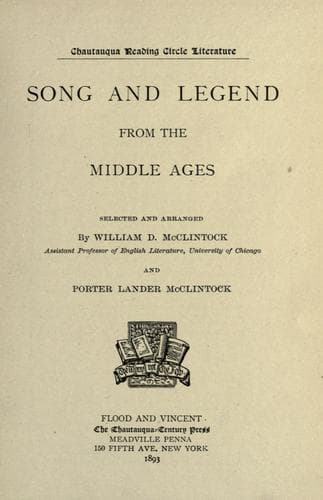
Literature, Medieval -- History and criticism; Literature, Medieval -- Translations into English
The fields unsown
Shall yield their growth;
All ills shall cease;
Balder[2] shall come,
And dwell with Hauthr[3]
In Hropt's[4] abodes.
Say, warrior-gods,
Conceive ye yet?
A hall she sees
Outshine the sun,
Of gold its roof,
It stands in heaven:
The virtuous there
Shall always dwell,
And evermore
Delights enjoy.
[1] Fimbultyr, Odin.
[2] Balder, the god of the summer.
[3] Hauthr, Hoder, the brother of Balder.
[4] Hropt, Odin. of Odinic morality and precepts of wisdom, in
the form of social and moral maxims.
--Tr. by Henderson.
HAVAMAL.
The High-Song of Odin. This is the second song in the Elder Edda.
Odin himself is represented as its author. It contains a pretty
complete code.
All door-ways
Before going forward,
Should be looked to;
For difficult it is to know
Where foes may sit
Within a dwelling.
. . . .
Of his understanding
No one should be proud,
But rather in conduct cautious.
When the prudent and taciturn
Come to a dwelling,
Harm seldom befalls the cautious;
For a firmer friend
No man ever gets
Than great sagacity.
. . . .
One's own house is best,
Small though it be;
At home is every one his own master.
Though he but two goats possess,
And a straw-thatched cot,
Even that is better than begging.
One's own house is best,
Small though it be;
At home is every one his own master.
Bleeding at heart is he
Who has to ask
For food at every meal-tide.
. . . .
A miserable man,
And ill-conditioned,
Sneers at everything:
One thing he knows not,
Which he ought to know,
That he is not free from faults.
. . . .
Know if thou hast a friend
Whom thou fully trustest,
And from whom thou would'st good derive;
Thou should'st blend thy mind with his,
And gifts exchange,
And often go to see him.
If thou hast another
Whom thou little trustest,
Yet would'st good from him derive,
Thou should'st speak him fair,
But think craftily,
And leasing pay with lying.
But of him yet further
Whom thou little trustest,
And thou suspectest his affection,
Before him thou should'st laugh,
And contrary to thy thoughts speak;
Requital should the gift resemble.
I once was young,
I was journeying alone
And lost my way;
Rich I thought myself
When I met another:
Man is the joy of man.
Liberal and brave
Men live best,
They seldom cherish sorrow;
But a bare-minded man
Dreads everything;
The niggardly is uneasy even at gifts.
Public-domain text, read in full here on John Shaqi.
Reviews
Reviews
No reviews yet
Be the first to share your thoughts on this work.
Join the Discussion
Join the discussion
Sign in to leave a comment or review.
Sign InorCreate an account