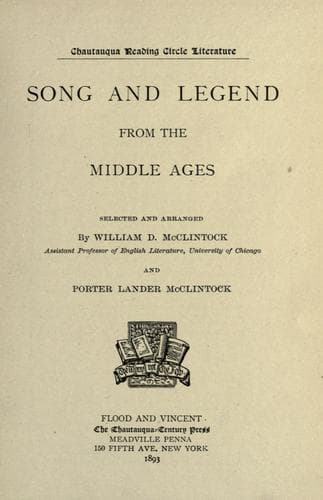
Literature, Medieval -- History and criticism; Literature, Medieval -- Translations into English
My garments in a field
I gave away
To two wooden men:
Heroes they seemed to be
When they got cloaks:[1]
Exposed to insult is a naked man.
. . . . .
Something great
Is not always to be given,
Praise is often for a trifle bought.
With half a loaf
And a tilted vessel
I got myself a comrade.
Little are the sand grains,
Little the wits,
Little the minds of men;
For all men
Are not wise alike:
Men are everywhere by halves.
Moderately wise
Should each one be,
But never over-wise;
For a wise man's heart
Is seldom glad,
If he is all-wise who owns it.
. . . .
Much too early
I came to many places,
But too late to others;
The beer was drunk, or not ready:
The disliked seldom hits the moment.
. . . .
Cattle die,
Kindred die,
We ourselves also die;
But the fair fame
Never dies of him who has earned it.
Cattle die,
Kindred die,
We ourselves also die;
But I know one thing
That never dies,
Judgment on each one dead.
[1] The tailor makes the man.
--Tr. by Thorpe.
VAFTHRUDNISMAL. THE SONG OF VAFTHRUDNER.
From the third poem in the Elder Edda came the following lines,
describing the day and the night:
Delling called is he
Who the Day's father is,
But Night was of Norve born;
The new and waning moons
The beneficent powers created
To count years for men.
Skinfaxe[1] he is named
That the bright day draws
Forth over human kind;
Of coursers he is best accounted
Among faring men;
Ever sheds light that horse's mane.
Hrimfaxe[2] he is called
That each night draws forth
Over the beneficent powers;
He from his bit lets fall
Drops every morn
Whence in the dells comes dew.
--Tr. by Thorpe
[1] Skinfaxe (shining mane), the horse of Day.
[2] Hrimfaxe (Rime mane), the horse of Night.
CHAPTER IV. GERMAN LITERATURE.
There are three classical periods in German literature.[1]
[1] See Scherer's "History of German Literature." Vol. I., page
16.
1. The Old High German Period, culminating about 600 A. D. The
chief development of this period is the epic legend and poetry.
As this literature remained largely unwritten, it is all lost
except one fragment, The Song of Hildebrand.
2. The Middle High German Period, culminating about 1200 A. D.
This was in Germany, as elsewhere in Europe, a time of abundant
literary activity. It is the period of the renaissance of the
heroic legends of the first period, and their remaking into
developed epic poetry; of the writing of romances of chivalry and
of antiquity; of the development of the lyric poetry of the
Minnesingers; of the growth of popular fables and tales and of
the drama. In short, all the forms of literary production known
to the Middle Ages flourished in Germany in this period.
3. The Modern Classical Period, culminating about 1800 in the
work of Goethe, Schiller, and the many poets and scholars
surrounding them.
THE NATIONAL EPIC.
Public-domain text, read in full here on John Shaqi.
Reviews
Reviews
No reviews yet
Be the first to share your thoughts on this work.
Join the Discussion
Join the discussion
Sign in to leave a comment or review.
Sign InorCreate an account