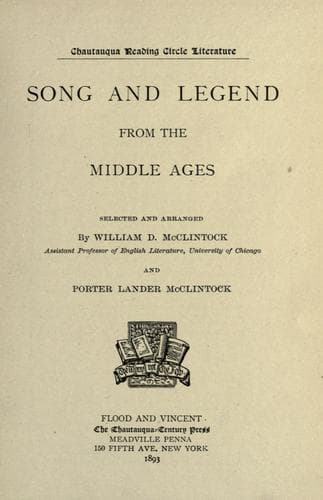
Literature, Medieval -- History and criticism; Literature, Medieval -- Translations into English
French Literature of the Middle Ages was produced between the
eleventh and the fifteenth centuries, having its greatest
development in the twelfth and thirteenth centuries. It must be
divided into two sections according to the part of France where
it was produced.
I. French Literature proper, or that composed in the northern
half of France.
II. Provencal Literature, or that developed in Provence.
The most obvious difference between these is that the Provencal
literature had little of the epic and romantic, but developed the
lyric extensively, especially lyrics of love.
The following table will show the more important kinds of French
Mediaeval Literature.[1]
[1] This classification is adapted from M. Gaston Paris'
excellent sketch "La Litterature Francaise au Moyen Age", 1890,
and Saintsbury's "Short History of French Literature", 1889.
I. Narrative Literature.
1. The National Epics.
2. Romances of Antiquity.
3. Arthurian Romances.
4. Romances of Adventure.
5. Tales and Fables.
6. Chronicles.
II. Didactic Literature.
1. Allegories--"The Romance of the Rose".
2. Satires.
3. Homilies, etc.
III. Lyric Literature.
THE NATIONAL EPICS.
The French national epics (called "Chansons de Gestes", songs of
heroic deeds) are those narrative poems which are founded on
early French history, and recount the deeds of national heroes.
They are, for the most part, based on the deeds of Charlemagne
and his nobles. They are peculiar to Northern France. Their date
of production extends from the eleventh to the fourteenth
century, their best development being in the eleventh and
twelfth.
These epic poems number more than one hundred. They vary in
length from one thousand to thirty thousand lines. The whole mass
is said to contain between two and three million lines. Like all
folk epics, they are based upon earlier ballads composed by many
different poets. These ballads were never written down and are
completely lost. The epic is a compilation and adaptation,
presumably by a single poet, of the material of the ballads. In
every case the names of the poets of the French epics are lost.
They were trouveres and their poems were carried about in memory
or in manuscript by the jongleurs or minstrels, and sung from
castle to castle and in the market places. The best of them are:
"The Song of Roland"; "Amis et Amiles"; "Aliscans"; "Gerard de
Roussillon"; "Raoul de Cambrai". Of these the oldest and
confessedly the greatest is The Song of Roland, from which our
extracts are taken.
Public-domain text, read in full here on John Shaqi.
Reviews
Reviews
No reviews yet
Be the first to share your thoughts on this work.
Join the Discussion
Join the discussion
Sign in to leave a comment or review.
Sign InorCreate an account