Literature, Medieval -- History and criticism; Literature, Medieval -- Translations into English
The number of tales in circulation in Mediaeval Europe was
exceedingly large. These tales came from many different sources:
from Oriental lands, introduced by the Moors, or brought back by
the crusaders; from ancient classical literature; from traditions
of the church and the lives of the saints; from the old
mythologies; from common life and experience. Among many
mediaeval collections of them, the most famous are the
"Decameron" of Boccaccio, and the "Geste Romanorum", a collection
made and used by the priests in instructing their people.
V. DIDACTIC AND ALLEGORICAL LITERATURE.
Under didactic literature we would include a large mass of
writing not strictly to be called pure literature--sermons,
homilies, chronicles, bestiaries, and chronologies. Nearly all
these were written in verse, as prose did not begin to be used
for literature until very late in the Middle Ages.
The mediaeval mind, under the influence of the scholastic
theology, grew very fond of allegory. The list of allegories is
exhaustless, and some of the allegories well-nigh interminable.
It is not easy to say whether the "Romance of Reynard the Fox" is
a series of fables or an allegory. The fact that a satire on
human affairs runs through it constantly, warrants us in calling
it an allegory. Some phase of the Reynard legend formed the
medium of expression of the thought of every mediaeval nation in
Europe. Perhaps the most popular and influential allegory of the
Middle Ages was "The Romance of the Rose", written in France but
translated or imitated in every other country. Dante's "Divine
Comedy" is an allegory of a very elevated kind.
VI. THE DRAMA.
The origin and line of development of the drama in all the
countries of Mediaeval Europe is this: Dramatic representations
in connection with the liturgy of the church were first used in
the service; then they were extended to church festivals and
ceremonies. By degrees portions of Bible history were thrown into
dramatic form; then the lives of the saints furnished material. A
distinction grew up between Mystery Plays--those founded on Bible
history--and Miracle Plays--those founded on the lives of the
saints. These plays were performed both in the churches and in
the open air. They were written usually by the clergy. Gradually
there grew up a play in which the places of religious characters
were taken by abstract virtues and vices personified, and plays
called Moralities were produced. They were played chiefly by
tradesmen's guilds. Alongside the sacred drama are to be found
occasional secular dramatic attempts, farces, carnival plays, and
profane mysteries. But their number and significance are small.
The mediaeval drama is historically interesting, but in itself
does not contain much interest. It is impossible to give an idea
of it by selection.
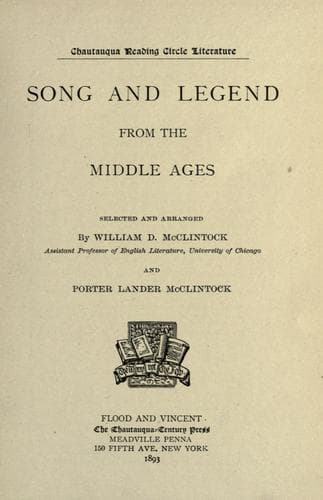
SONG AND LEGEND FROM THE MIDDLE AGES.
CHAPTER I. FRENCH LITERATURE.
Public-domain text, read in full here on John Shaqi.
Reviews
Reviews
No reviews yet
Be the first to share your thoughts on this work.
Join the Discussion
Join the discussion
Sign in to leave a comment or review.
Sign InorCreate an account