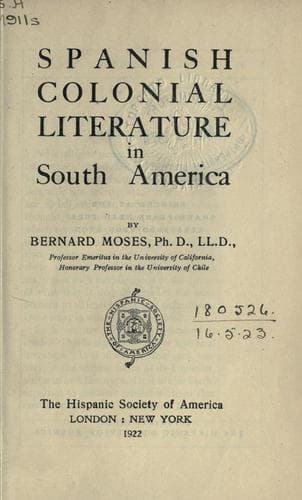
Spanish colonial literature in South AmericaMoses, Bernard
History
Spanish colonial literature in South America
Moses, Bernard
Spanish American literature -- History and criticism
The expedition of Ortiz de Zárate or the voyage from San Lucar to Santa
Catalina is described in the eighth canto. It was carried in two small
and three larger vessels. In receiving his appointment as governor of
Paraguay Zárate had agreed to introduce into the colony a number of
labourers as colonists, a quantity of arms, and also a large number of
horses, cows, sheep and goats within a period of three years. The greater
part of the animals were to be brought from the ranges near Charcas and
Tarija. The little fleet halted at Gomera, the Cape Verde Islands, and
Santa Catalina; and on this passage from Santa Lucar and during the
stay at Santa Catalina the expedition lost three hundred persons. Among
the survivors was the Franciscan missionary, Luis Bolanos, who was the
first to apply grammatical rules to the Guaraní language, and the first
dictionary of the language is attributed to him.
[Sidenote: Famine at Santa Catalina]
In spite of storms, the voyage was fortunate until the vessels passed
into the calm and heat of the tropics, where all suffered to such
a degree that they would gladly have returned to Spain. But their
sufferings were greatly intensified after they reached the island of
Santa Catalina, where scores of Spaniards died of starvation. The ninth
canto sets forth the horrors of this episode, and it is dedicated to “las
damas.”
El canto vuestro es, pues que contiene
De damas y galanes la caída:
Centenera exposes the details of the famine, pointing out that every
animal and reptile, however repugnant at first, was at last found to be
as savoury as the flesh of a kid, for
La gran hambre prestaba salmorejo.
The extremes to which men were driven by hunger are narrated at length,
the crimes committed to obtain food, and the unusual punishments meted
out to the criminals who were detected. But many escaped detection. Some
persons encountered a dog alone. They killed him immediately, and without
waiting to have him well cooked or roasted, devoured him, in order to
avoid being recognized as the offenders by the arrival of the owner.
Another person, having stealthily entered an inn kept by two women, was
apprehended by them; then without pity they cut off his ears, and nailed
them up on the house, either for decoration or as a warning to other
thieves. Recognizing that they had acted without justice, and that they
ran a risk of being punished, they returned the ears to their owner
accompanied by a quantity of food sent “to shut up his mouth.”
[Sidenote: Last stage of the voyage]
Public-domain text, read in full here on John Shaqi.
Reviews
Reviews
No reviews yet
Be the first to share your thoughts on this work.
Elsewhere in the archive
Join the Discussion
Join the discussion
Sign in to leave a comment or review.
Sign InorCreate an account