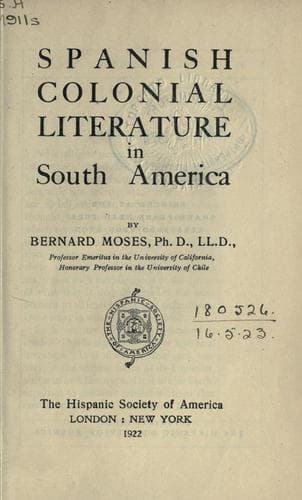
Spanish colonial literature in South AmericaMoses, Bernard
History
Spanish colonial literature in South America
Moses, Bernard
Spanish American literature -- History and criticism
Zárate, having determined to proceed to Río de la Plata, sought from
every source food to serve for the voyage, and in this search the Indians
were deprived of whatever they possessed. By this their good-will was
completely alienated. The incidents of the voyage and the landing
constitute the theme of the tenth canto. The company had apparently not
learned by their experience to view with calmness the varying phases of
the sea, and when the sparkling waves rose to the stars, the women wept
and the men uttered great cries, all assured that they were to be buried
in the ocean. And after the storm had subsided, and they had approached
the port of San Gabriel, a furious south wind arose, wrought havoc in the
rigging of the vessels, and drove one of them upon the shore. Thus after
a day of joy the passengers were overwhelmed in grief and agony (Canto X,
Oct. 14):
Pilotos y maestres, marineros,
Grumetes, pajes, frailes y soldados,
Mujeres y muchachos, pasajeros,
Andaban dando voces muy turbados.
[Sidenote: Among the Charrúas]
Having landed, after the storm, they found themselves among the Charrúas,
who seemed to Centenera to possess qualities that entitled them to be
ranked with the Araucanians (Canto X, Oct. 27).
La gente que aquí habita en esta parte
Charruahas se dicen, de gran brío,
A quien ha repartido el fiero Marte
Su fuerza, su valor y poderío....
Es gente muy crecida y animosa,
Empero sin labranza y sementera:
En guerras y batallas, belicosa,
Osada y atrevida en gran manera.
[Sidenote: Fight with the Indians]
The Charrúas occupied the region between Maldonado and the Uruguay. They
had met with hostility the earlier explorers of the Río de la Plata, and
they continued in hostile relations with the Europeans until they were
finally exterminated in 1831. In an encounter between the forces of
the chief Zapicán and Zárate’s soldiers, all but a few of the Spaniards
were either killed or captured by the Indians. Centenera presents an
abundance of details concerning this encounter, and refers to the action
of Zapicán’s forces in the following spirited lines (Canto XI, Oct. 18):
El zapicano ejército venía
Con trompas y bocinas resonando;
Al sol la polvareda obscurecía,
La tierra del tropel está temblando:
De sangre el suelo todo se cubría,
Y el zapicano ejército gritando,
Cantaba la victoria lastimosa
Contra la gente triste y dolorosa.[91]
[Sidenote: Character of _La Argentina_]
Public-domain text, read in full here on John Shaqi.
Reviews
Reviews
No reviews yet
Be the first to share your thoughts on this work.
Elsewhere in the archive
Join the Discussion
Join the discussion
Sign in to leave a comment or review.
Sign InorCreate an account